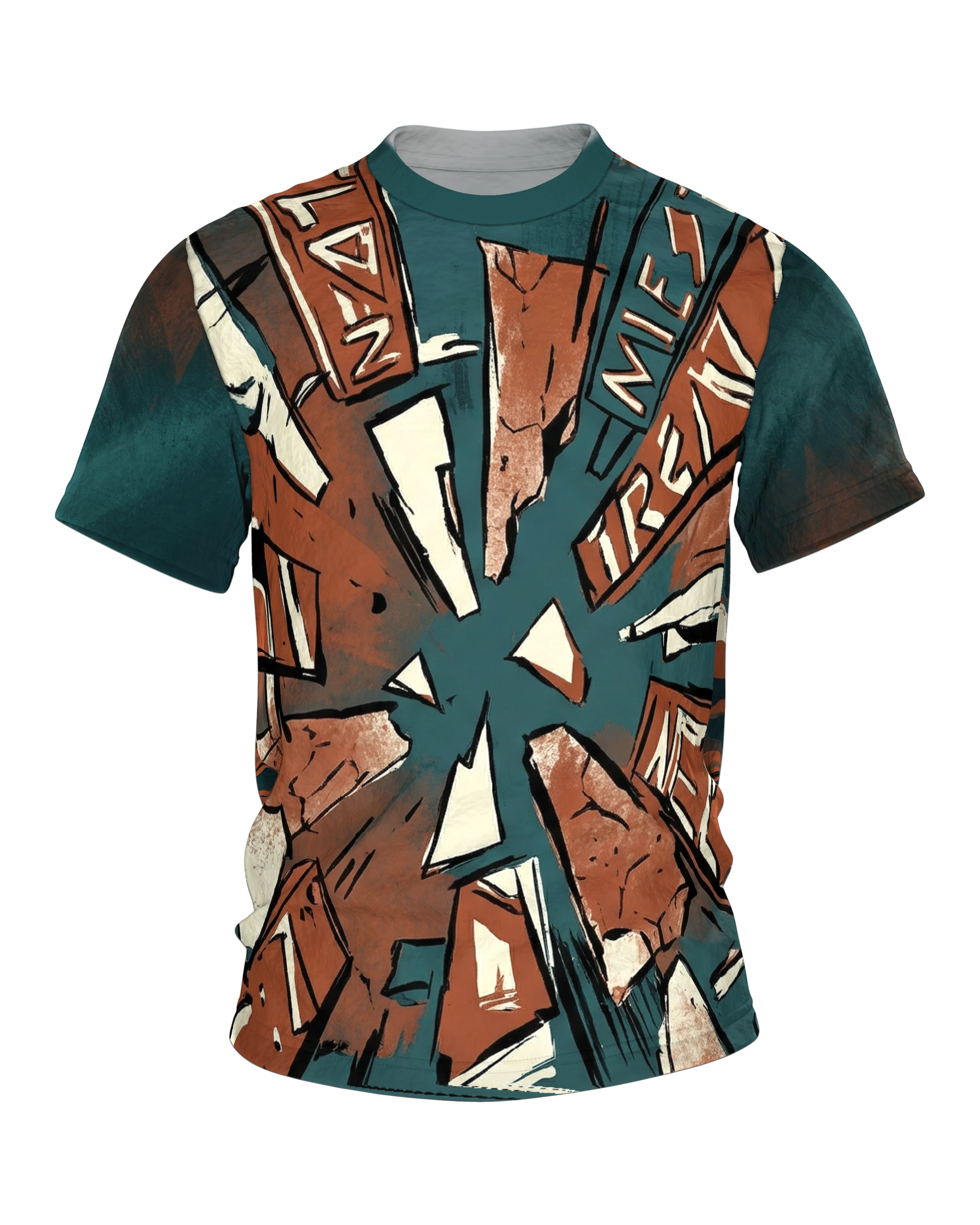
A centrifugal composition of shattered poster scraps, as if an advertising wall had exploded and its letters were flying radially out of the center of the image.
Product description
An Abstract Urban Art T-shirt begins with a look upward. You stand as if at the bottom of a narrow passage. All around, signs, boards and beams crowd in. Everything tilts upward and runs together, as if half the city center were vanishing into a single point. Exactly this pull is what the front carries. A canyon of advertising surfaces runs toward the middle like shattered signage. It is painted in teal, rust red and cream. Every edge is traced with a black outline. This is not a smooth graphic image. It is a poster collage with a visible brush, rough at the edges and still clear in its direction.
Letters sit on the boards, but they are broken. Only two fragments stay truly legible. 'TREND' runs diagonally up to the right, 'NEON' tips down to the right. The rest splinters into an alphabet that no longer wants to make sense. At the top left there is a line that even seems to stand on its head. That is what the noise of the advertising world sounds like when you walk right through it. A hundred promises at once, of which only one or two syllables stick in the end. The motif captures exactly that moment. The city turns into an overpainted collage, and lettering falls apart into pure structure.
Anyone who has walked through a shopping arcade in the evening knows the play of reflections. Every pane of glass carries a different message. Every shop window lights up with a different name. In the end only the one sign stays in your head that your eye happened to catch. The front works with the same effect. It pulls the eye inward toward the middle, where all the beams meet. There an open area stays clear, with three pale triangles pointing into it. From there it sends the eye back up along the edges. Calm and unrest lie close together.
The back deliberately takes the tension out and lets the colors run free. There is no lettering here any more. Only broad brushstrokes in the same three tones overlap, cross and wedge into one another. Most of them rise from the lower left corner up to the upper right. On the front a sharp-edged architecture of boards appears, on the back it turns into pure painting. An abstract field of blue-green and warm rust, shot through with cream-colored bands. It carries the movement of the front side onward without repeating it. On the front the order of the signs, on the back the free play of gesture.
The color choice carries much of the mood. Teal feels cool and urban, almost like dusk between building fronts. The rust red sets the warm, slightly corroded metal tones of old signs against it. The cream opens up the surface so the canyon does not become oppressive. Together the three produce a sound that stays modern. Even so it keeps a slightly vintage, weathered note, as if the sun had already bleached the posters for a while.
Worn, this makes a calm, dense picture. From a few steps away you mainly read the large form. The concentric canyon and the interplay of the three colors then carry it alone. Only closer up do the individual boards step forward. Along with them the fine black lines and the places where the paint has been dragged dry across the ground. That keeps the image interesting for weeks. It speaks differently at a distance than up close, and with every look it pushes a different fragment to the front.
It is easy to wear. On dark denim and heavy boots the front looks most uncompromising. With light pants and lightweight sneakers the painterly character comes forward instead. Because the colors stay muted, the image never forces itself on anyone. It reads like a worn piece of the city that you chose on purpose.
As an Abstract Urban Art T-shirt, this piece is meant for everyone who likes urban art on the body. It does not have to be loud or in your face for that. It is for people who read design the way others listen to music. For everyone who likes to drift through galleries and record stores. And for anyone who understands the appeal of a collage in which every fragment keeps its fixed place.