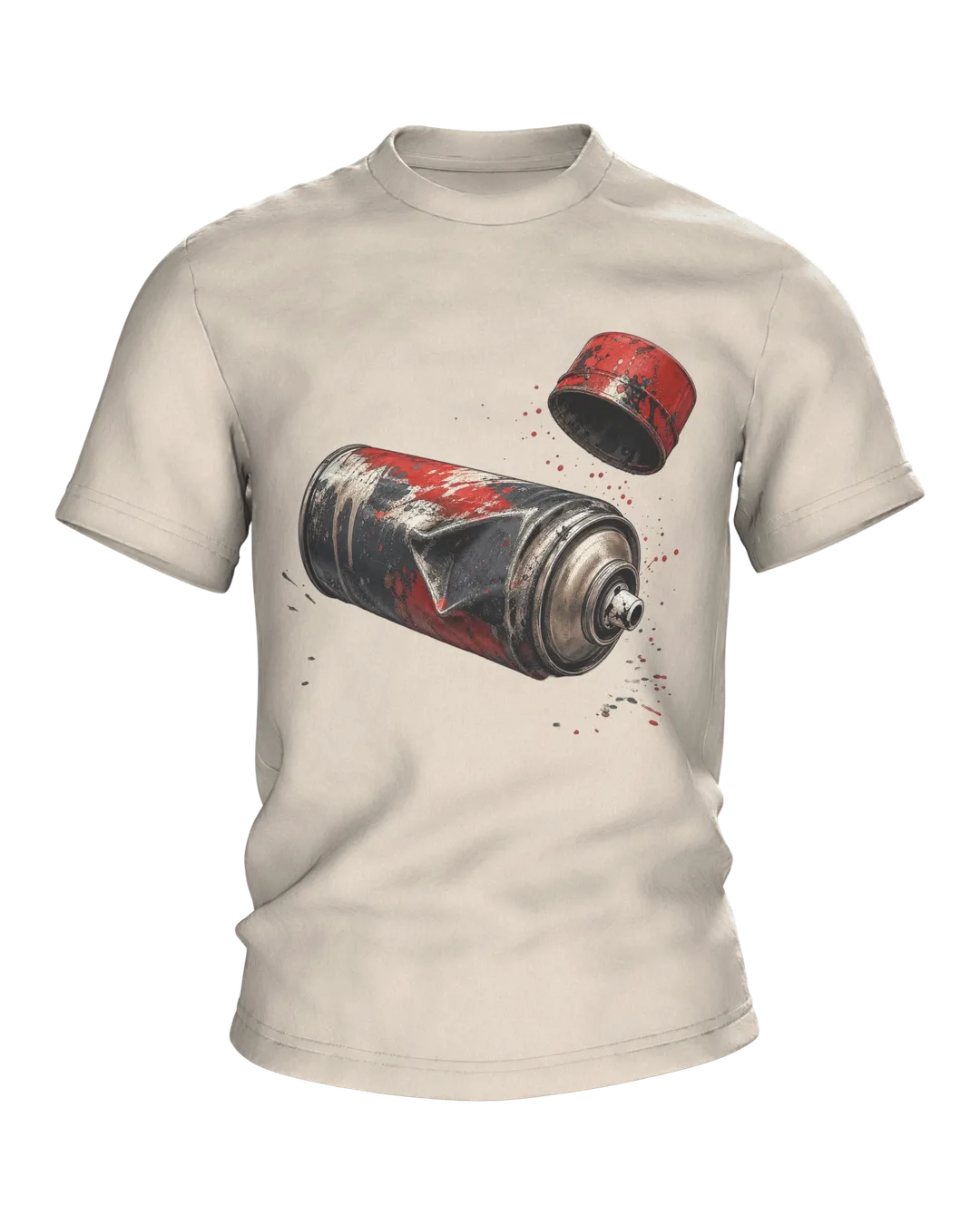
On this shirt a dented spray can lies across the image, with the red cap still floating in the air beside it. Chrome, black and a single signal red, plus a field of fresh paint splatters.
Product description
The price includes the front print. Add the back above under “Print”.
The Spray Can T-shirt shows a tool after the job is done: a can lies across the image, dented, coated in its own paint, and the red cap still floats in the air beside it. The scene is drawn so close up that you could count the scratches in the metal.
On the front the can runs diagonally through the image, its base at the upper left, its valve at the lower right. The paint was once black; pale drips run straight down the metal near the base, a broad, blotchy red covers the top of the body, and a second red band runs along its underside. In the middle someone has pushed the metal in, a sharp crease in which the light breaks. At the head sits a polished chrome dome with concentric rings, out of which the bare valve stem rises, open, with no nozzle on it.
At the upper right the cap floats, tilted, its inside dark, its outer skin red with black and white speckles. Between cap and can, round drops hang in space, as if someone had hit pause in the middle of the movement. No lettering, no mark, no manufacturer's name: this can belongs to nobody.
The back shows the same can from the opposite direction, the valve now pointing to the left. Here nothing is left of the paint, bare silver, folded into several planes like crumpled paper, with hard black splatters over it that run across the metal like flung ink.
Along the bottom edge the red gathers into a pool from which single drops run downward. The cap floats at the upper left, tipped over with its open side facing down to the right, letting paint drip from its rim. All around, densest to the left of and beneath the can, lies a ring of black splatter and spray dots, the remains of a cloud that has not yet settled.
In color the motif sticks to three tones: chrome silver, deep black and a signal red that tolerates no second chromatic color beside it. On dark fabric the bright metal surfaces step forward as if under studio light; on light fabric the black metal and the red stand out strongly. It is exactly this hardness that keeps the image readable from a few steps away as well.
Up close, looking pays off even more. Fine grinding marks lie on the chrome, a black rim clings to the valve stem, and the individual splatters are not flat but have edges and small halos, the way paint forms them on smooth metal. From two meters away what remains of all this is the silhouette of the can and a red field beside it.
The artistic trick lies in time. Everything is caught in a single second: the cap in the air, the drops just before they fall, the mist still hanging. A Spray Can T-shirt with this frozen movement says more than any painted motion line, because the eye involuntarily waits for things to run on.
The motif is worn by people who work with their hands: by writers on legal walls, by vehicle painters, scenic painters and sign painters, by everyone who knows that good gear carries scars. Because the can bears neither a name nor a crew mark, it belongs to no scene and shuts none out either.
Because the motif is cut out and the fabric shows directly behind it, it works with dark and light clothing alike. A red detail on a shoe or a cap picks up the one chromatic color, and no further pattern is needed beside it.
As a gift it lands with those whose fingers are rarely completely clean: for passing the exam in the painting trade, for a first exhibition of one's own, for moving into a first studio. It also suits people behind the camera, because a captured fraction of a second is the same craft there.
Front and back together make two shots of the same moment. Looking from the front to the back, you see the cap first flying and then dripping, the can first painted and then bare. The Spray Can T-shirt therefore carries no illustration but a short scene in two pictures.