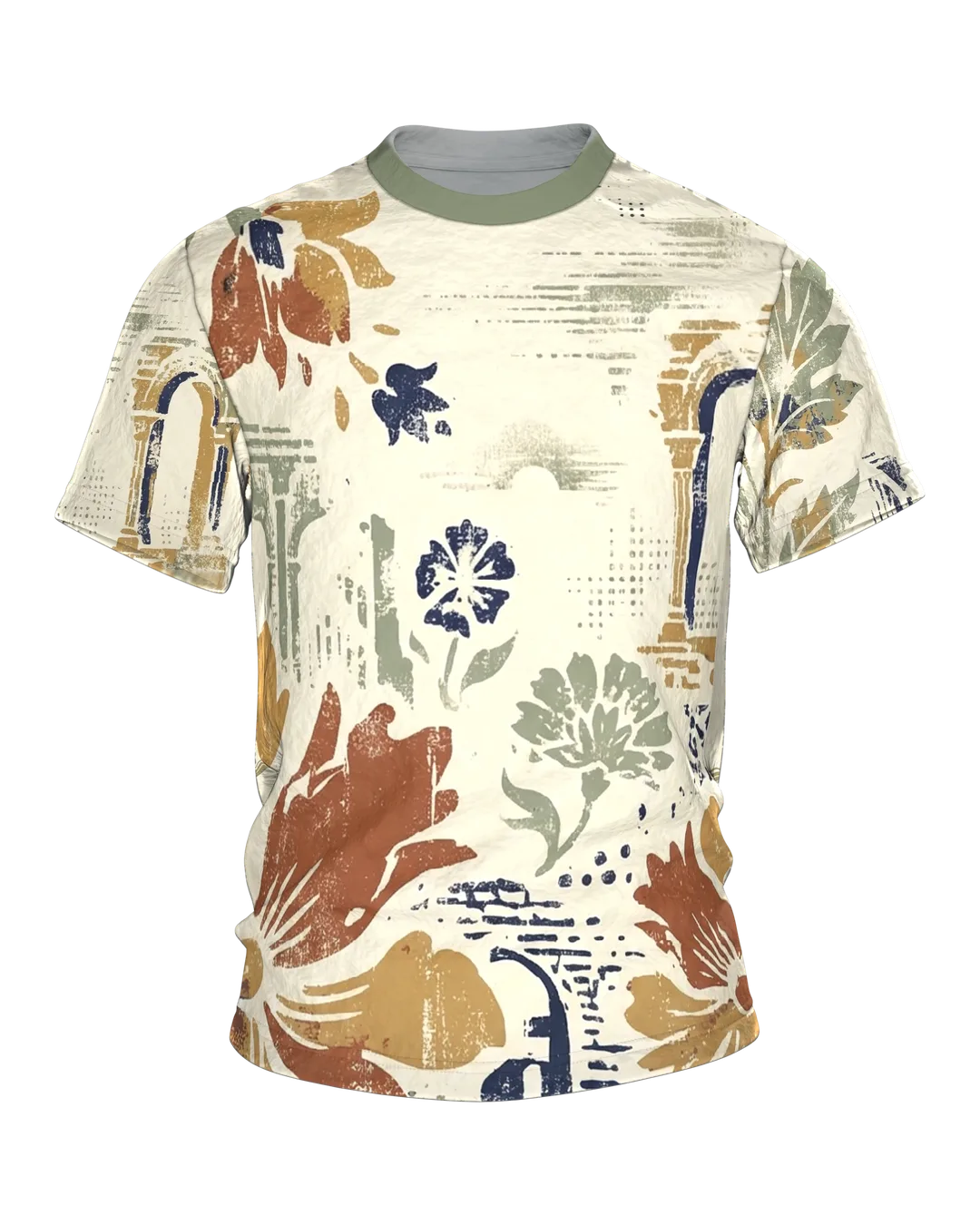
A block print collage on a cream ground: a sage green arcade, an ocher round arch with a blue shadow and large stamped blooms in rust and ocher, plus dot grids like those on old paper.
Product description
The Vintage Floral Architecture T-shirt gathers up what is left of a journey when you stamp it instead of photographing it. On a cream ground, buildings and blooms lie side by side, without a frame and without an order. Every shape found its place wherever there was still room, and on the front none of them repeats.
Four colors are enough for this picture, plus the light ground. Ocher, sage green, rust red and a very dark blue. Three of them come from the same family, from clay, soil and dried grass. The blue does not belong to it, and that is exactly why it is needed. It sets the points where the eye comes to rest and keeps the warm surfaces from running into one another.
At the top the front carries architecture. On the left stands a sage green arcade with a cornice and slender columns, on the right an ocher round arch answers it, its inner edge accompanied by a deep blue shadow. In the middle, set further back, a pale arch pushes into the picture, so faded that it looks as if someone had set the stamp a second time without taking new ink.
Between them lie signs that mean nothing. Rows of fine dots, horizontal strokes, a grid like the one on an old punch card. They fill the space between without explaining it. Look longer and you read window bands, masonry or writing that is not writing. This game keeps the collage in motion, even after the tenth look.
One detail sits far up, almost at the shoulder. There a bell shaped bloom hangs upside down into the picture, rust red and ocher, with a blue petal in the middle, and a few ocher drops come loose from it as if they were falling right now. It is the only shape in the picture that appears to move.
Toward the bottom the balance tips. The blooms grow larger the closer they come to the hem, and the buildings step back. At the very bottom the hem cuts the last blooms in half, so you have to imagine the rest of them. That does not look like a mistake but like a page that keeps going.
At the very bottom, right among the blooms, sits something blue made of nothing but short strokes. It could be a bridge pier or what is left of a balustrade, the picture does not commit that precisely. Only one thing is certain: this piece of stonework does not stand up at the shoulder, it holds the heavy blooms down at the ground.
Every surface looks as grainy as an impression from a hand stamp. In places the ink lies thinner, edges fray, small gaps stay open. That gives even the strictest arch something soft. What looks hand printed forgives irregularity, and here that irregularity is the real appeal.
The back slows things down. There a single branch grows from the bottom upward, shifted slightly off center. Its lobed leaves shift within a single leaf between rust, ocher and sage green, as if autumn had started in the middle of the impression. Behind it lies a loose block of green smears.
Front and back tell the same thing at different volumes. The chest is full and dense, the back holds only one plant and a lot of open ground. Whoever comes from the front sees a small town full of blooms. Whoever walks behind sees a branch and a lot of paper.
There is no lettering, no number, no slogan. The design demands nothing and claims nothing, it simply lies there and lets itself be read. That is why it suits people who like the south, old courtyards, tiles, pots full of blooms. And everyone who would rather wear muted colors than loud ones.
In the end it is a collection and not a pattern. A pattern repeats itself, this collage hardly does: on the front every bloom, every arch, every field of dots appears exactly once, and only the two sleeves pick up the ocher arch, the dot grid and the leaves again. That is why every fresh look turns up something you had missed before.