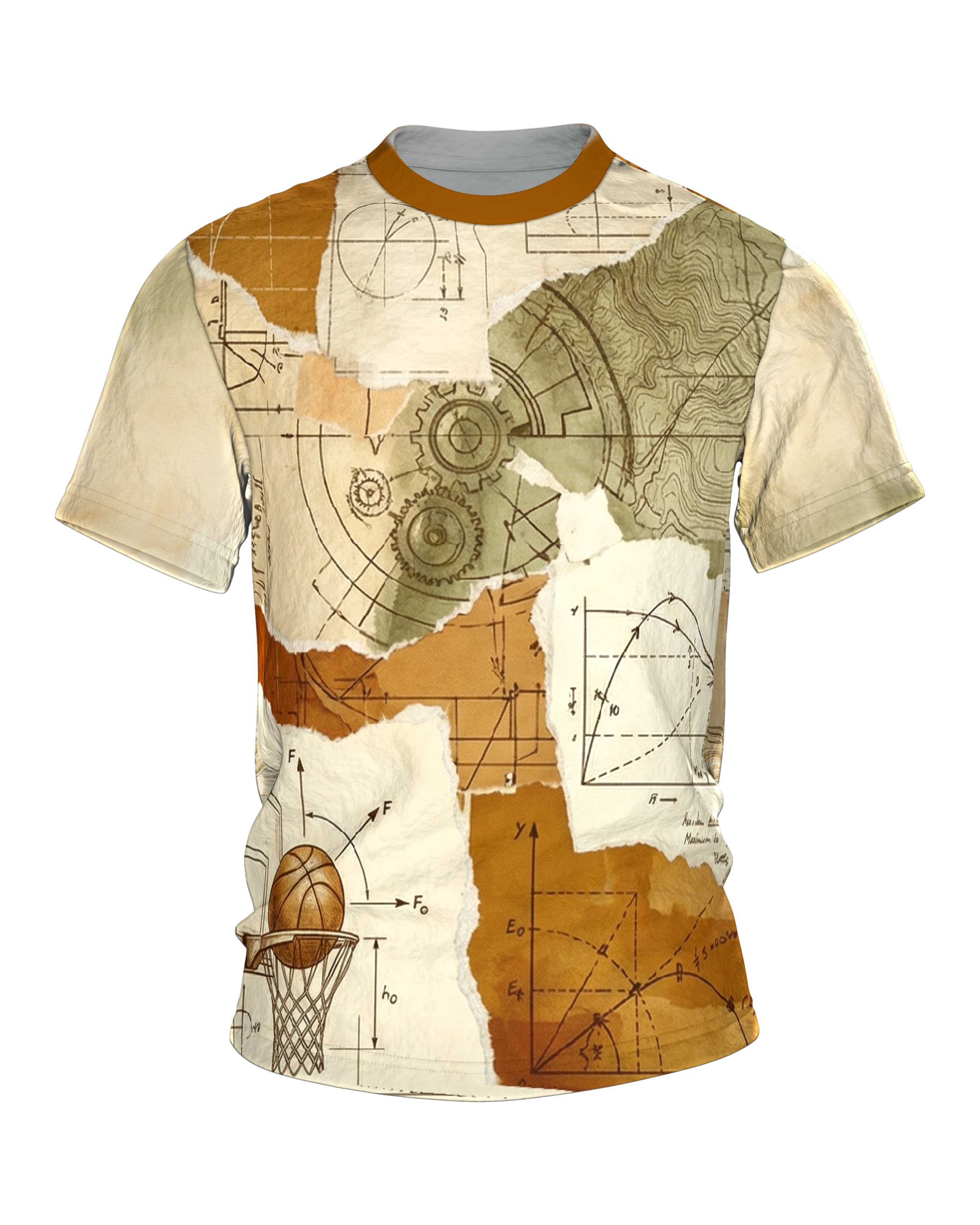
A collage of torn sheets of paper, like the board of a physics teacher trying to explain basketball. Every scrap of paper says something different:
Product description
Two seconds of flight, one crash at the rim: this Slam Dunk T-shirt reveals what sits behind the cheering, namely science. From the outside a dunk looks like pure inspiration, but the truth is far more planned. Across both sides of the shirt runs a collage of torn, yellowed sheets of paper on which someone has taken the perfect layup apart with the greatest patience, into curves, forces, angles and plays, drawn as if from the estate of an engineer who lost his heart to basketball.
The front holds the heart of the physics. Down at the hem waits a finely hatched hoop with a ball, surrounded by force arrows that show everything pulling and pushing in that one moment. Above them, shot parabolas stretch across diagram sheets, neatly marked with measuring points, and beside them drawn gears mesh into one another, as if the sequence of movement were a machine you could oil. In between: dimensions, guide lines, handwritten margin notes and hatched areas that look like maps of the jump.
The back moves from the lab into the locker room. Court diagrams stack up there in several versions, the floor seen from above with zones and circles, plus tactical sketches full of arrows describing running paths the way they have been scribbled on boards for decades. Two old-fashioned stopwatches with finely drawn dials are a reminder that in the end the last second always decides, and a tattered sheet titled Manual gives the whole thing the dryly funny tone of an instruction leaflet for a miracle.
The appeal of this split lies in its truth. On the front hangs what a single body has to deliver: takeoff, angle, force. On the back hangs what a team has to deliver: spaces, paths, timing. Anyone who has ever stood in a gym knows that one is worthless without the other, and this shirt is probably the first piece of clothing to document that division of labor properly.
Color-wise the collage stays in warm archive sepia: ochre, rust brown, olive green and the cream of old paper. No neon, no club red, no poster colors, and that is exactly what makes the shirt so unusually wearable. It looks more like a library than a gym and therefore works in both worlds, over training pants just as well as with a brown corduroy jacket.
It is meant for everyone who wants not only to play basketball but to understand it. For players who still analyze video after practice. For coaches whose tactics folders look exactly like this back. For sports students, stats nerds and dads who quietly mutter angles from the sideline. And for anyone who loves the court but is looking for a shirt that also cuts a good figure in the lecture hall, the office and the cafe.
Worn, the collage unfolds its appeal in stages. From a distance the shirt reads as a warm, textured vintage pattern; as you come closer you make out hoop, curves and watches; and whoever stands right in front of it starts to read. There are hardly any better conversation openers, and certainly none on the court. Even people with no connection to the hoop get caught on the collage, because old paper with diagrams has a beauty of its own, almost archival, otherwise found only in antiquarian bookshops. Add to that the practical side effect of every dense collage: small creases and long days disappear visually into the pattern, and in the evening the shirt still looks the way it did in the morning.
The handwriting holds the eye longest. Below the diagram sheet runs a line in faded ink of which only the word Maximum can be read for certain; everything before and after it loses itself in loops. Two shot curves run across it and cross, and the crossing point itself carries a single D. Here someone was not decorating but calculating, and what remains is his notebook. The same patience sits in the gears at the center of the image: three of them, meshing together, the smallest barely bigger than a thumbnail, each one toothed and hatched individually, as if the pen had had all the time in the world.
That leaves the finest insight of this sport, and it is written on both sides: gravity does lose sometimes, but never without a run-up. On the front hangs the calculation, on the back the plan, and between them lie the two seconds that make the whole effort worth it. Whoever wears this finally gives preparation a face.