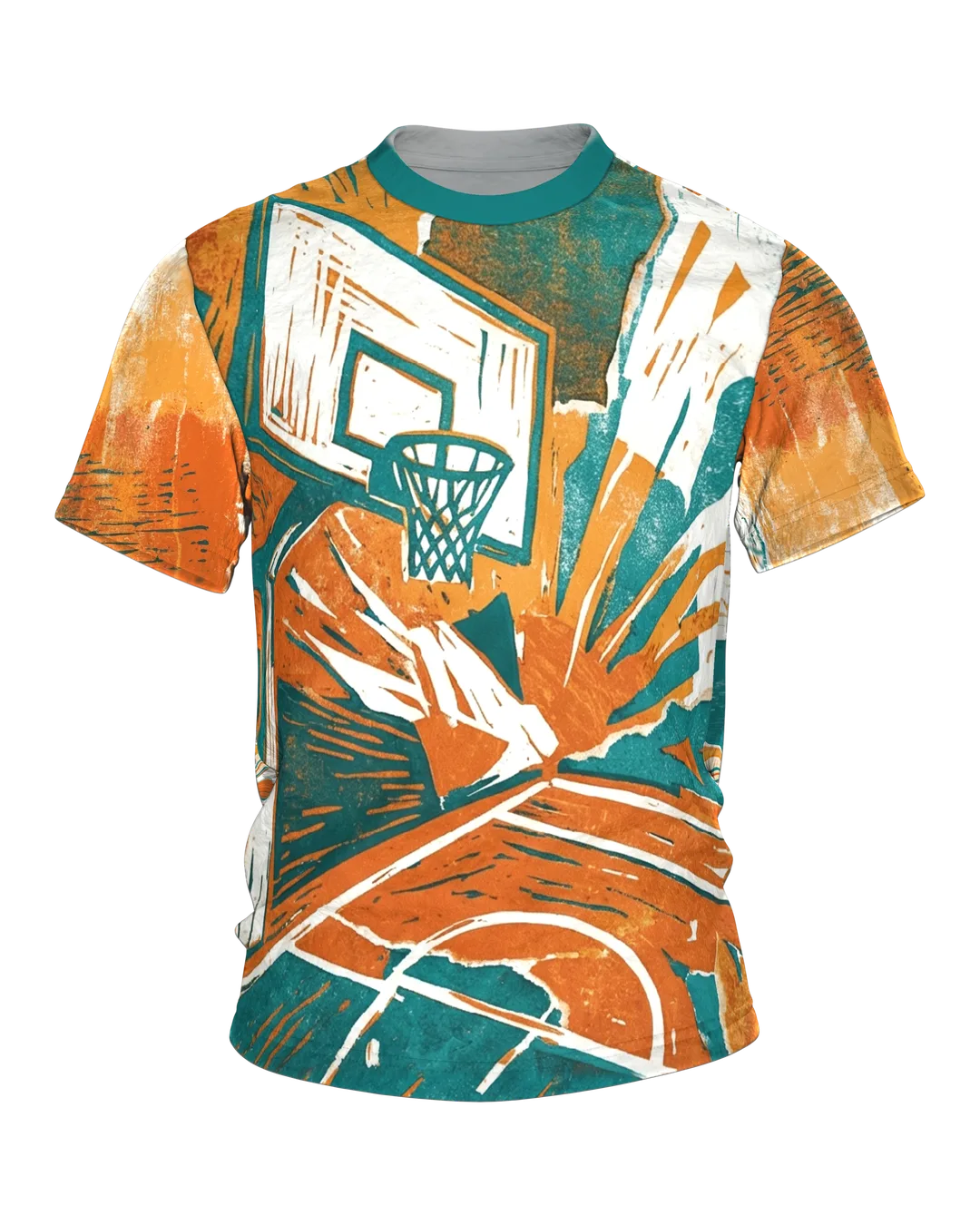
The view goes steeply up to the hoop: a pale backboard with a teal frame, the rim in teal, below them the net of diamonds. On the right a burst of orange wedges breaks open, at the bottom the free-throw arc tips away into the depth.
Product description
The Basketball Dunk T-shirt carries a basketball hoop on the front, seen steeply from below. The backboard stands in the image as a pale cream surface, outlined by a strong line in teal. A narrow orange edge runs along its outer rim. Inside sits the target square, also in teal, with the uneven edge of a cut block. The rim below it is a teal curve with an orange stripe flashing on top. The net hangs down as a diamond grid in the same color. There is no ball and no player figure. The hoop stands alone, and the view goes steeply upward.
Right below the rim the surface breaks open. From a single point, wedges drive apart to the right and upward, broad and pointed at once. The largest ones are solid orange, and between them stand pale spikes of cream and narrow triangles in teal. This shape fills the entire right half and works like the instant after the dunk. No shadow, no motion blur, only rays driving out of a center. That is where the force of the image comes from, even though nobody is playing in it.
In the lower third the floor tips forward. The free-throw arc runs as a pale line across an orange surface. Next to it lies the lane in teal, bounded by further cream lines that waver slightly. They were not drawn but cut from the block, and you can see it in them. Look closely and you find fine dropouts in the lines and places where the ink covers more thinly. The court runs out of the image at the bottom, as if you were standing in the middle of it yourself.
The whole front follows the language of the linocut. There are no gradients and no soft transitions, only surfaces, edges and cut strokes. The large fields carry a grainy texture of the kind a roller leaves on rough paper. At the borders the shapes break away, and in some places the pale ground stays exposed. Three colors are enough: a cool teal, a warm orange and the cream of the paper. The motif needs no more than that to stay clear from a few steps away.
The back tells the same thing, only without order. There, surfaces in teal, orange and cream lie on top of one another, with torn edges and broad pale gaps between them. One element stays recognizable: a tilted square in teal on an orange ground, the target field from the backboard. Everything else is fragment, plus bundles of parallel strokes of the kind a dry roller pulls. At the top left a large pale zone stays open, at the bottom right the colors crowd together. That creates a balance you only notice on the second look.
The sleeves stay in this world as well. Short strokes in teal lie over orange fields, set close together and pulled dry. They pick up the hatching of the front without claiming a motif of their own. From the front, from the back and from the side, everything belongs together. The difference between the parts is a question of density, not of subject.
This T-shirt speaks to people who like basketball and still do not want to wear a jersey. It names no club, no number and no name. It shows only the place where the thing happens, and the moment afterwards. The same picture holds for the outdoor court as for the gym. Anyone with the hoop in their head recognizes it at once, everyone else sees a strong graphic in three colors.
From a distance you read the contrast first: a pale backboard in a strong teal frame, the burst of rays beside it on the right, and below it the orange floor. Come closer and the small things step forward, the grain in the surfaces, the gaps at the edges, the trembling lines of the lane. The image holds up at both distances. It stays a print you can wear and not a poster for the wall.