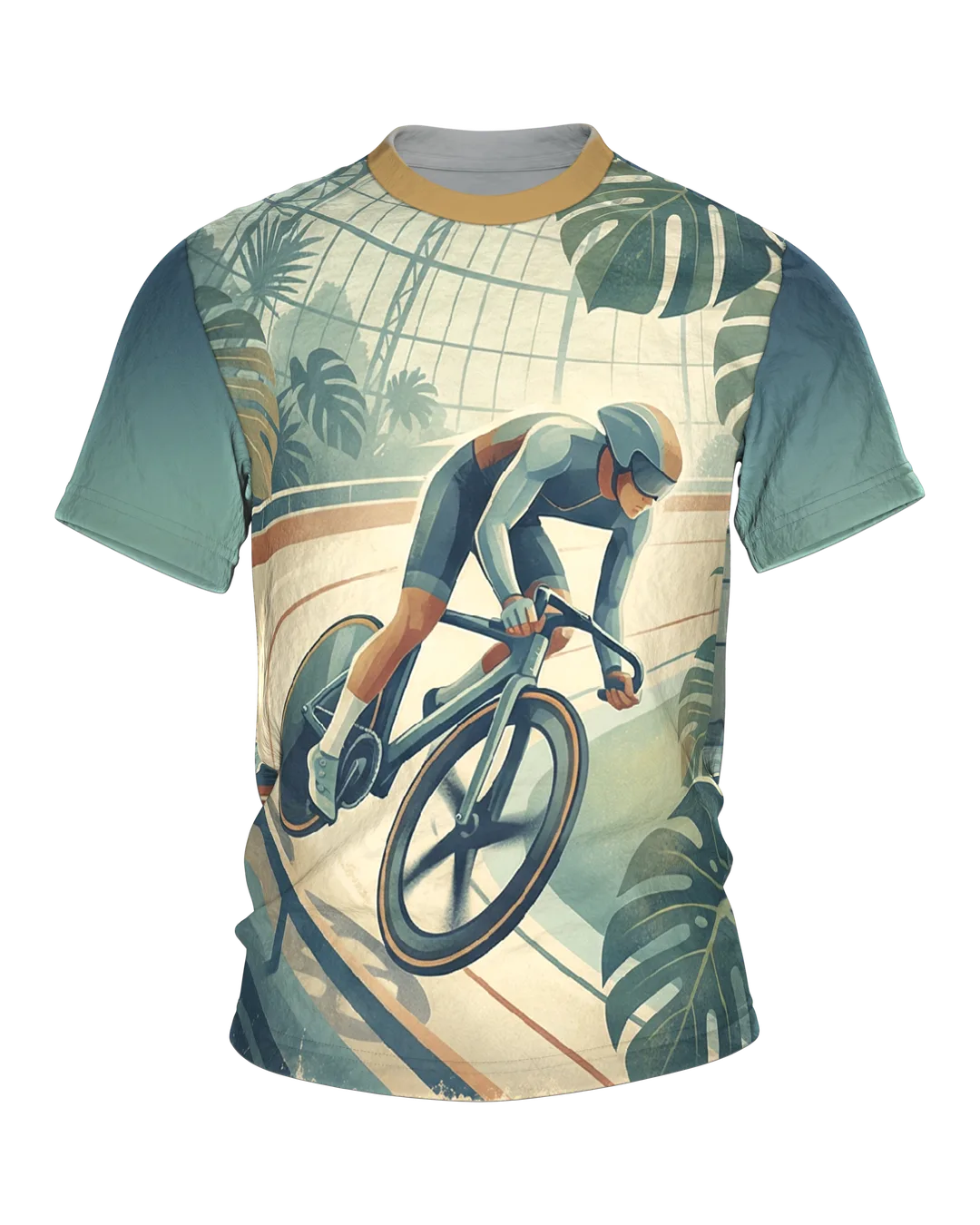
A sprinter pulls through the banking in a low crouch, above him a glazed dome arches instead of an arena roof, and heavy monstera leaves hang into the picture from the right edge.
Product description
Who says speed and greenery have to be kept apart? This Track Bike Velodrome T-shirt claims the opposite and acts as if it had never been any different. At the front a sprinter chases through the banked curve, chin over the stem, one hand on the bar right beside it, the other low in the drop. Above him there is no arena roof but a glazed dome whose glazing bars stretch across the scene like a net. And because that is not contradiction enough, heavy monstera leaves hang in from both edges of the picture, on the right as a broad curtain, on the left a single one next to a palm frond, wide as oar blades and in no hurry at all.
The palette stays remarkably calm through all of it. Teal and dusty blue carry the background, cream and sand the track surface, terracotta draws the lines, and a single coral red sits as a seam on shoulder and sleeve. Add a fine grain over everything, worn edges, a light frame: the look of old sports posters that hung in a clubhouse for decades and gently faded in the process. Nothing dazzles, nothing shouts, and yet you see at once where the movement sits.
Anyone who knows the sport picks up on the small truths as well. At the rear runs a closed disc wheel, at the front an open, spoked one, and both carry a copper-colored ring on the rim. At the front the spokes blur into a veil, as if the camera had stayed open one blink too long. The body stands exactly at the angle of the lean, and the markings of the track swing along at the right spacing. Anyone who has never dealt with track cycling sees a beautiful picture with a quiet joke inside it. Both were intended.
The arrangement is a decision too. The track runs from the top left to the bottom right and lays a strong diagonal across the surface, while the leaves at the side edges hold against it like a heavy curtain. At the bottom left a dark blue rail with its vertical posts secures the infield. From two steps away you read movement, from thirty centimeters the veins of the leaves. This double legibility is the difference between a pattern and a picture.
On the back it goes quiet. There the same building stands without people: two glass domes, the larger one cropped by the left edge, the flatter one behind it on the right. Dark, pointed tree shapes show through the panes. The sky runs from deep teal at the top into a pale green at the horizon, and at the top right cream-colored lines run horizontally through the picture, with rounded turns of the kind old travel posters used for rushing air.
At the bottom the curve swings in once more, framed on the outside by a dark blue band, on the inside in terracotta that tips into amber toward the middle. That is how the two sides complement each other: at the front the moment in which the muscles work, at the back the afternoon afterward, when only the glass creaks and a fan hums somewhere. The same hall, two different minutes, and you wear both at once.
The motif is made for two kinds of people who overlap more often than you would think. To the first a velodrome means wood, noise and fixed gears, they know banked curves from their own experience and like the fixie culture of the city. To the second, green means a windowsill full of pots, a palm house in January, a Sunday in the orangery. Here the two come together without either side having to give way.
In everyday life the muted color world is the real trick. It goes with denim blue, with sand and with off-white, it clashes with almost nothing and looks pleasantly grown-up next to loud sports graphics. You can wear it to the cafe, to the trackside or into the greenhouse, and in all three cases it looks as if you had owned the picture for a long time. That was exactly the plan: a motif that does not smell of novelty but of habit.