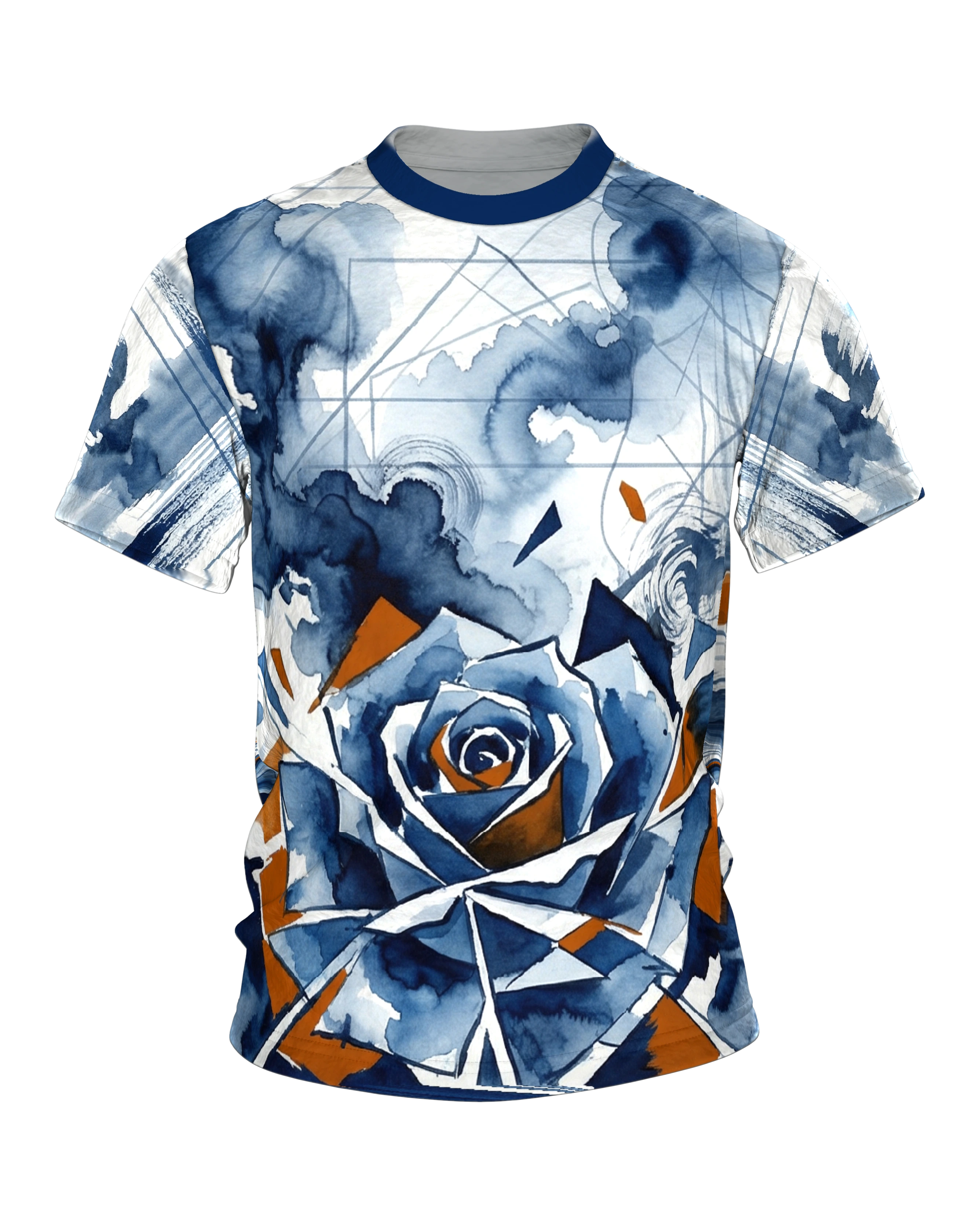
A rose shattered into geometric splinters, every petal built from hard polygon facets instead of soft curves.
Product description
The Polygon Rose T-shirt begins where a flower stops being pure decoration and starts becoming construction. On a light, almost paper-white ground, a large watercolor rose opens up in the lower third of the image in inky indigo and cool steel blue. Its petals, however, do not stay round: at the edges they break into angular shards, into triangles and narrow splinters, as if the same rose had been painted and taken apart into its geometric building blocks at the very same moment.
Between the blue facets, splinters flash in warm rust orange. They sit like inlaid pieces of copper in a mosaic and give the cool image its counterpoint, a spark of warmth inside the analytical blue. Above the flower, clouds of ink smoke rise, soft and diffuse, while fine line scaffolds stretch across them: diamonds, half grids, suggested frames that look like the guide lines of a drawing someone deliberately left in place.
Dry brush swirls turn through the open areas, circling traces that carry movement into the quiet composition. Fine spatters set the last accents. All the white space around it works like the mat around a framed sheet: it gives the motif air, separates analysis from dissolution, and holds the shards together without locking them in.
On the back the design leaves the rose out entirely. Only the language of the splinters remains: blue and rust-colored triangles pushing apart from the center, circled by dry swirls and loose ink stains on white. Front and back tell the same thought in two chapters, one representational, the other purely abstract.
What makes this design special is the tension between two kinds of mark-making. The watercolor areas flow softly into each other, their edges staying wet and unpredictable, the way pigment simply travels into paper. The geometric edges, by contrast, are hard and deliberate, almost drawn with a ruler. The entire image lives in exactly that contradiction, between the flowing and the built. The rose therefore never looks finished, but always frozen in the moment of its transformation.
This motif is made for people who like floral forms but shy away from sugary romance. Anyone who values architecture, graphic design, and clear construction will find the rigor of geometry here; anyone who loves watercolor and a visible hand will find the delicacy of the color. The two stand side by side without either one overruling the other.
Up close you first read the individual facets, the damp color edges, the borders of the triangles, the transitions from deep blue into light gray. Step back a few paces and the shards assemble into a recognizable rose, and from a distance a calm blue shape on a light field is all that stays. The same picture therefore changes with the viewer's distance.
This sheet is not hung on a wall but worn on the body. It is a drawing in motion whose center of gravity sits low, while the upper half stays almost empty. At the top right a half arc runs off into nothing, and right next to it stands a rectangle missing one edge. Unfinished helper shapes like these keep the empty space open instead of filling it, and only they give the flower below its weight.
In terms of color the piece stays pleasantly calm. The deep blue carries the surface, the rust orange sets only a few deliberate accents, and the white keeps everything in balance. That makes the shirt easy to combine: with denim it feels completely natural, with black the graphic character turns even stricter, with sand or gray the rose steps gently into the foreground. It is a garment that never pushes and still gets noticed right away.
In the heart of the flower the rust orange takes the lead for the only time. A narrow spiral wraps around the innermost eye and runs out below it into a broad, almost bronze area. All the remaining rust stays a footnote: a triangle at the left petal edge, a narrow wedge at the bottom right, a flashing sliver between two blue facets. So the rose stays, between analysis and dissolution, exactly where it belongs: between the drafting table and the garden, between break and bloom.