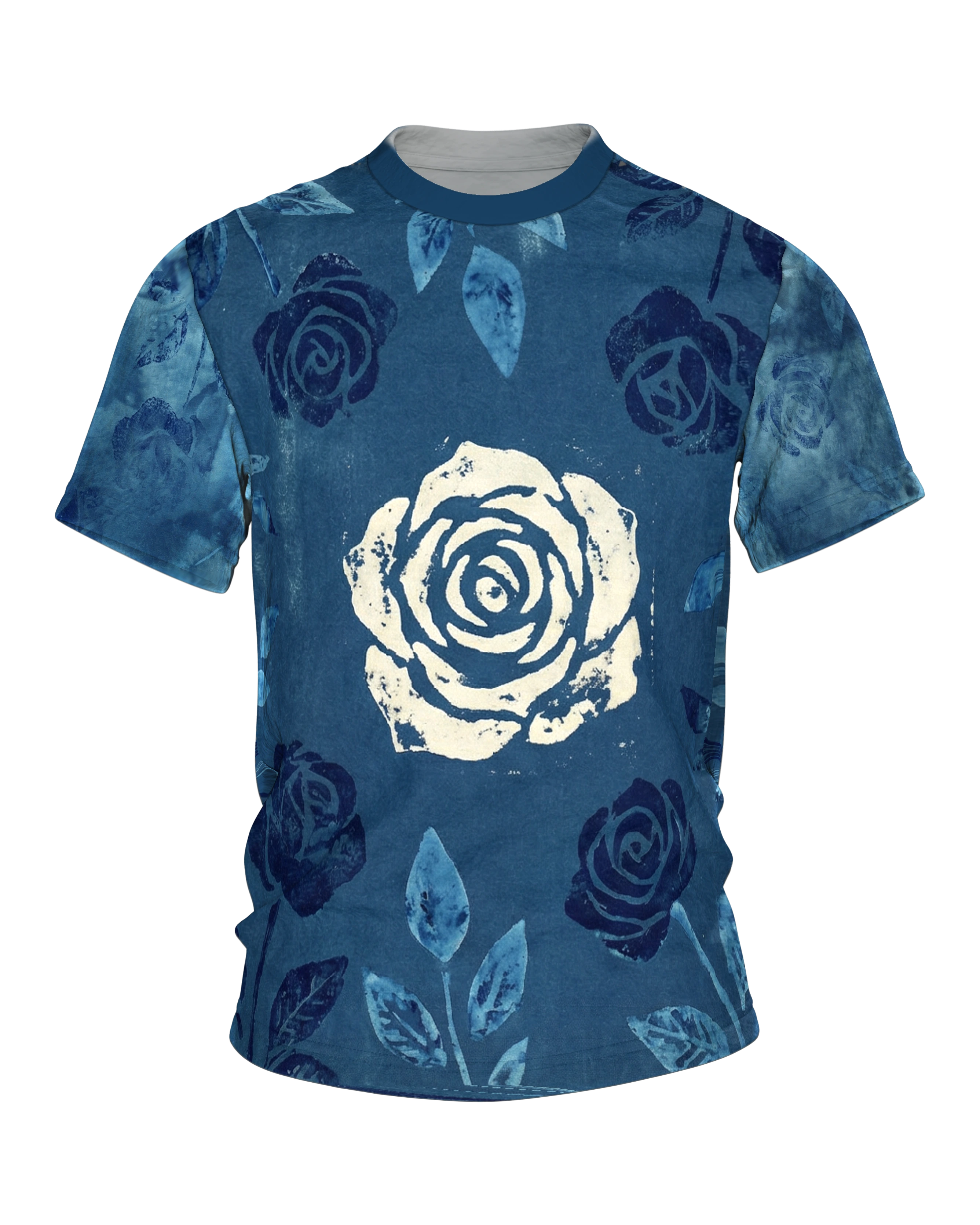
A classic wallpaper symmetry: at the center of the image sits a large cream-white rose in printmaking style, and around it, offset outward, four smaller, almost black indigo roses.
Product description
This Indigo Wallpaper Tile T-shirt brings the oldest way of making fabric beautiful back onto the body: hand block printing. Roses and leafy branches spread across a rich denim blue. They look as if someone had stamped them on one by one with carved wooden blocks. That comes with everything hand printing brings along: uneven ink pickup, velvety squeeze edges and the quiet pride of a pattern that did not come out of a test tube.
The center of the front belongs to a large cream-white rose: it lies free on the denim blue, with no frame, no box, no lightened field beneath it. Its outline follows the petals alone, and blue speckles sit inside the cream white, as if the block had not given off the same amount of ink everywhere. Those very gaps are the charm; the pattern shows where it comes from instead of hiding it. Around the white queen four dark blue roses are grouped, almost black against the blue of the ground. Between them light blue leafy branches wander through the image as if through an old salon fabric.
The back lets go of the center and becomes pure repeat. Roses, a bud on its stem and leafy tendrils spread evenly across the surface. Dark on blue and light on blue alternate, like a strip of wallpaper that never ends. This is the meditative side of the design, not an eye-catcher but a rhythm, and that is exactly why it feels so refined; good patterns need no middle.
Anyone who knows print history reads the arrangement like a small manifesto. The front quotes the pattern book, where a single proof print sits next to the repeat. The back is the repeat itself. A garment that shows draft and finished product at the same time: that has existed on the wall, in the archive or in the museum, but hardly ever in the wardrobe.
The palette stays inside a single color family and uses all of it. Deep night blue sits in the dark roses, denim blue in the ground. Added to that are a cloudy light blue in the leaves and the cream white of the main bloom. It is the color world of indigo dyeing, at home on every continent, from Japanese workshops through Indian print houses to European manufactories, and standing for the same thing for centuries: care.
Worn, the shirt has a rare double talent: it is a patterned shirt that behaves like a basic. The blue goes with everything denim has ever managed, and the pattern stays tonal and calm. The white rose gives the look exactly one accent, no more. With white pants it turns summery, with dark jeans you get denim on denim with a touch of nobility, and under a cardigan the central rose stays visible like a window.
It belongs to people who take interiors seriously. Those with the beautiful wallpapers and the framed fabric samples, the admirers of old manufactories, the flea market block print collectors and everyone who goes weak at the knees for pattern books. And it is a quiet sign of recognition among design people; whoever can place it usually says something nice. The pattern has also proven itself across generations: it hangs on no youth aesthetic and no retro joke, but on a craft tradition, and that, as everyone knows, suits every age.
Count the roses once, it is worth it. Four dark blooms surround the light center: two above it, two below it, each offset outward. Between them light blue leafy branches run across the field and take the hardness out of the strict order. That equation, one center and four answers, is the oldest idea of order in pattern making. Here it works so quietly that you only notice it on the second look.
As a gift it works everywhere you would otherwise give beautiful things for the home, except that this one comes along when you leave the house. Every bloom looks individually stamped, with visible handwriting. The white rose takes on the job of every good dedication: it turns the pattern into a counterpart. And as with every good counterpart: you see it first, but you stay for everything else.