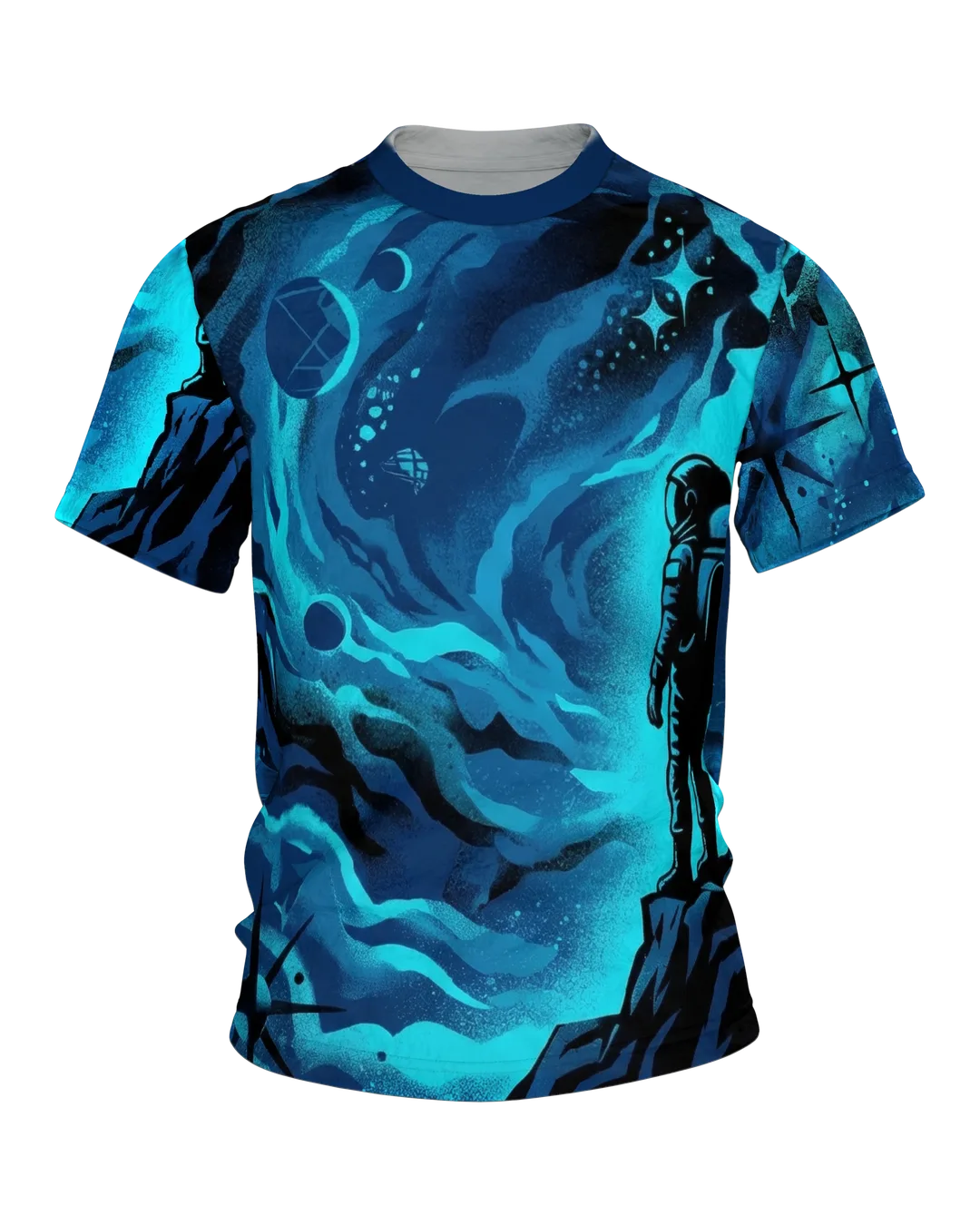
On the right, an astronaut stands on a rock ledge as a dark silhouette with a turquoise outline. On the left, a spray-style spiral nebula turns in navy blue and teal, with an eight-pointed star at the lower left.
Product description
The Astronaut Nebula T-shirt shows a person who stops and stands still. On the right side of the image an astronaut stands on a rock ledge, in profile, looking to the left, arms hanging loosely at his sides. He is a black silhouette, and only a thin turquoise line traces the helmet, the backpack and the folds of the suit. Half the sky lies in front of him.
This sky is a vortex. Across the left two thirds of the front a nebula of spray-style bands turns, with a grainy texture, soft edges and dark cores. Its arms run inward counterclockwise, grow brighter toward the center and tip into turquoise along their edges. Behind the figure stands a broad glow of light that sets it off from the ground.
In the upper left hangs a large dark disc, a planet with a narrow crescent of light along its right edge. Straight lines and edges run across the disc, as if someone had started to survey it. A little above it sits a small crescent moon. Below, a swarm of bright chunks drifts through the picture, and in the middle of it floats a cut crystal with fine inner lines.
In the lower left stands an eight-pointed star, a dark silhouette over a glowing core, its left ray running out of the picture. It sits there like a compass rose on an old sea chart. Above the helmet two four-pointed stars sparkle, a large one and a smaller one, and next to them broken-off pieces of rock drift by. At the bottom right the rock ledge pushes into the picture with hard, flat edges.
The composition is simple and still does its work. Everything bright gathers in the center, everything dark frames it, and the figure stands exactly on the border between the two. Your eye travels around the vortex in a circle and catches on the figure every time. Because the human figure stays small, the nebula looks large.
The back turns the scene around and shows what lies behind him. In the upper left a bright disc with dark bands stands above the plain. A band of stardust runs diagonally through the picture from lower left to upper right, with dark veins and a greenish shimmer at its core. Below stand rock spires and flat mesas in graded shades of blue, and behind them the horizon glows turquoise.
The sleeves carry the same picture too. One holds a large eight-pointed star and beside it a small four-pointed one over a bright core, along with drifting rocks; on the other lie nebula bands, with a cropped compass star and the rock ledge where the astronaut's boots stand. Both share the same grainy texture. Front, back and sleeves all belong to the same scene.
The colors stay nocturnal throughout. Navy blue carries the surface, teal and turquoise set the light, an almost black blue forms the silhouettes. No warm tone disturbs the calm, no red, no yellow, no white. From two meters away the whole thing reads as a dark blue field with a bright vortex, up close as a complete scene.
Everything looks as if it were painted with hard stencil edges and soft sprayed areas. Sharp outlines meet visible grain, like a picture made with a spray can and a cut mask. Nothing about it looks photographic, and that is exactly what takes the coldness out of space.
Something like this is worn by people who step outside one more time at night just to look up. By visitors to the planetarium, by readers who have been stacking science fiction since their school days, by everyone who always stands on mountaintops for too long. As a gift it lands with anyone who wanted to be an astronaut as a child.
If someone asks what the crystal in the nebula actually is, you get to pick the answer yourself. The picture does not give it away. Space motifs usually show off with size; this one shows off with silence: no laser, no explosion, one person, one nebula and a great deal of night.