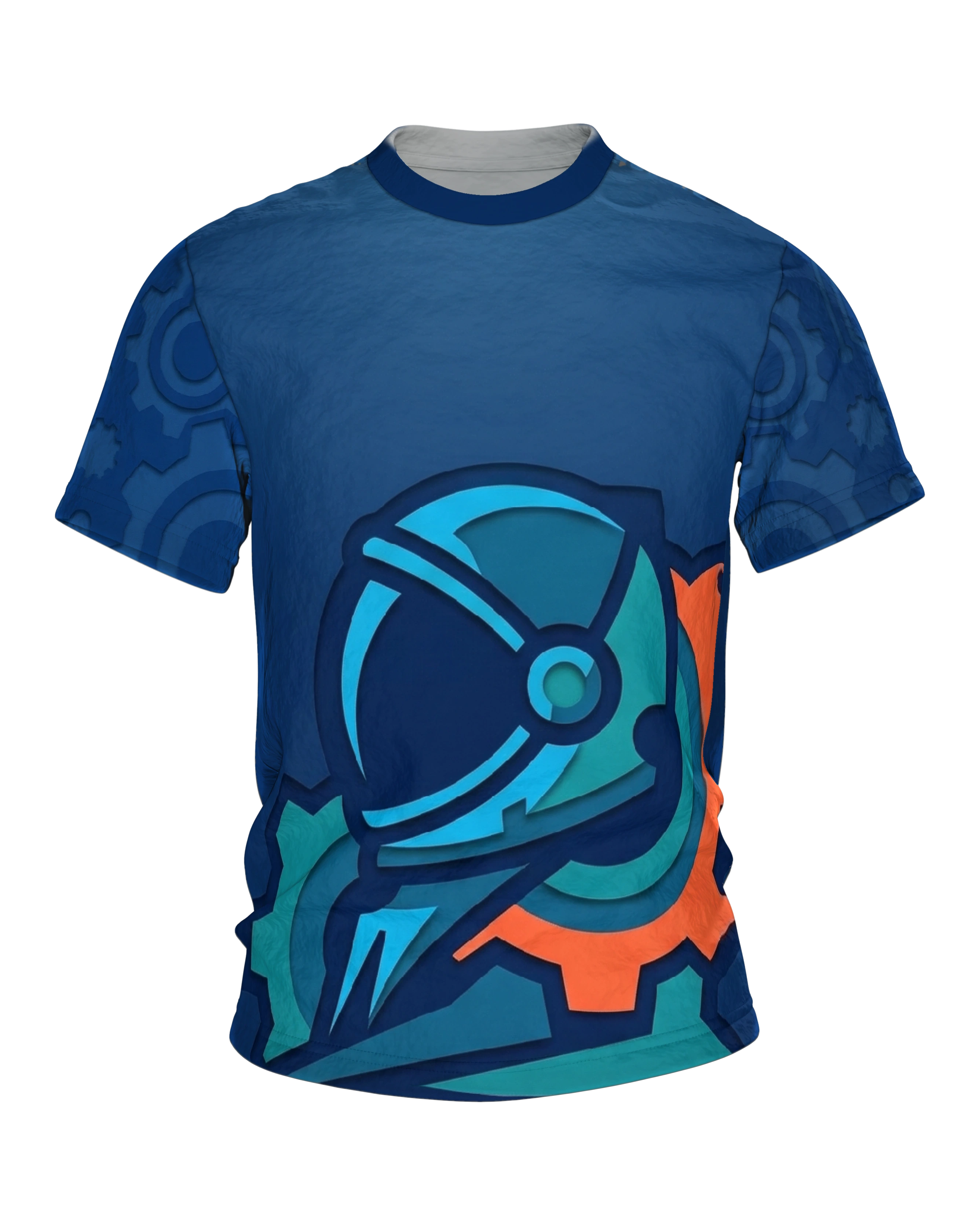
An astronaut helmet in cyan, an orange gear behind it, a smaller one in turquoise to the left: the emblem sits low on the front and runs out over the hem. On the back, a round tool badge.
Product description
The Astronaut Engineer T-shirt wears its sign strikingly low: the emblem only starts well below the chest, then runs broadly to the right and out over the hem. What you see is not an astronaut's portrait, but his helmet, and behind it the wheel that got him up there in the first place.
The helmet sits slightly tilted in the left half of the image. Its dome is deep navy blue, and bright cyan arcs lie across it like raking light on curved glass. Right of center sits a round connector ring: a bright cyan band on the outside, a turquoise-filled core inside, and at the lower left a piece of the band is missing. A narrow light blue bracket runs across the dome and bends away at its edge.
Behind the helmet an orange gear reaches into the picture. It is the largest single part and pushes far past the helmet's outline on the right. At the lower left stands a second, smaller wheel in muted turquoise, half hidden, half cut off by the edge of the image. At the very bottom a flat turquoise slope carries the scene like the ridge of a hill.
The placement is the real trick. The sign does not sit on the chest, where every logo sits, but low and shifted slightly to the right. Its lower edge does not end, it runs out of the picture. That makes the graphic look like a detail from something larger and not like a badge stuck on.
The whole thing is built like a paper-cut collage. Every field of color lies as its own layer over the next, each one casts a soft shadow onto the layer below, and a dark blue edge runs around every one of them. Within the fields almost nothing happens in terms of color. The depth comes purely from stacking.
Between the shoulder blades sits a round badge, about a third as wide as the back and placed exactly on center. Its ring of teeth changes color as it goes around: light cyan at the upper left, turquoise at the bottom, strong orange on the right side. In the dark core stand five flat parts: on the left an upright open-end wrench in orange, in the middle a tall turquoise shaft with a dark round hole, below it a turquoise angle piece, and on the right two orange bars, offset one above the other, that look like stepped blades.
The sleeves stay tone on tone. Both carry the same pattern, mirrored left to right: half gears, a tiny pinion and circuit traces with round contact points, all in a blue that is only a shade lighter than the navy around it. From two meters away you see nothing there. From half a meter you see everything.
In terms of color the design sticks to a few tones and lets them do the work. Navy blue carries, cyan and turquoise cool things down, orange sets the accent, and does so sparingly: the big wheel on the front, wrench and bars on the back. This restraint keeps the picture calm even though it tells a lot.
From a distance the motif reads as a single round shape, half helmet, half wheel. Only up close does it break apart into its layers: the bracket over the dome, the ring with the notch, the tooth flanks, the fine shadow edge between two shades of turquoise. So it gives you something twice, once at first glance and once at second.
It is meant for people who work on the technology behind the big pictures. For engineers, for mechatronics technicians, maintenance crews and machinists, for students of mechanical engineering and aerospace engineering, for everyone in the workshop whose hands still smell of oil in the evening. As a gift it fits a completed degree or the first day on a new shop floor.
In everyday life the motif gets along with almost anything already hanging in your closet. With jeans it stays casual, under an open jacket only the orange flashes through, and if you roll up the sleeves you expose exactly the circuit traces nobody else notices.
The Astronaut Engineer T-shirt claims nothing. It shows a helmet, a wheel and a badge full of workshop shapes and leaves the rest to whoever reads it. That is exactly why it works in the office as well as at the workbench.