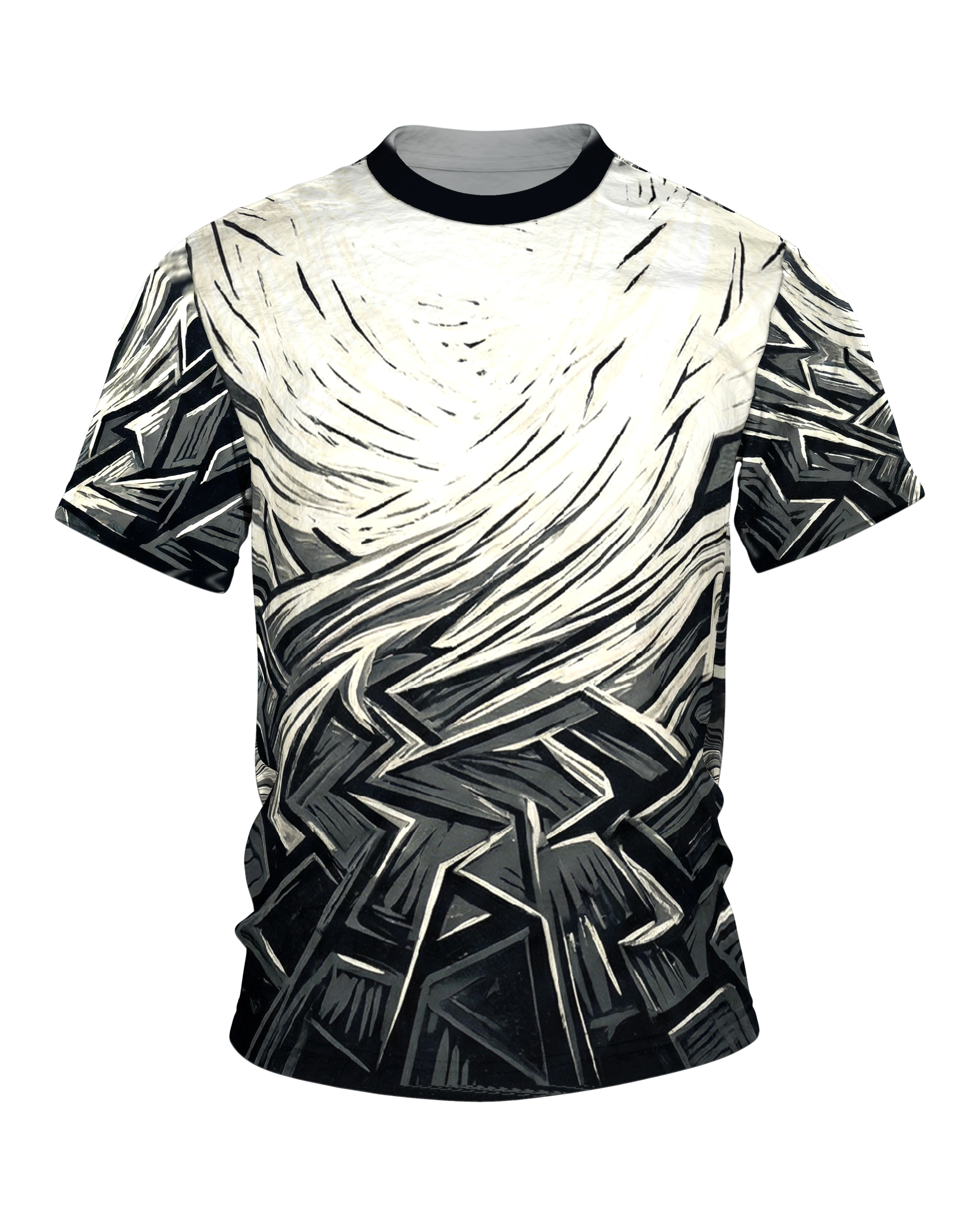
At the top, bright curved cut bands in cream that wedge downward into a field of dark splinters. On the back a vortex turns around a bright core. No text, no figure, only lines.
Product description
The Shattered Octagon T-shirt tells one movement in two chapters, and it does so without a figure and without a word. What you see are lines that look cut rather than drawn. That is where the whole idea lies: force itself cannot be pictured, but its trace can.
The woodcut is the oldest printing language in Europe and at the same time the most unforgiving. Once you cut a block, you take nothing back. Every chip that falls stays fallen. That is exactly why the Expressionists reached for this tool when they wanted to show force: angular edges, white notches, the visible resistance of the wood.
A cut produces a bright line, not a dark stroke on white. That inverts the logic of drawing. Everything bright in this motif was taken away, everything dark was left standing. Up close you can see the inversion at every edge: the bright bands are grooves, the black areas are what remains.
At the front it starts bright. Broad curved bands in cream run apart across chest and shoulders like a wave just before it breaks. Further down they lose their curve. Sweep turns into edge, edge turns into fragment. At the hem a dark field of splinters is left behind, densely packed and almost black.
At the back everything turns, literally. The back belongs to a vortex circling a bright core. Bands in cream, gray, and black pull inward, and between them lie cut fields full of fine parallel lines. The core is the calmest point of the motif. Anyone standing in front of it follows the rotation inward on their own.
Both sides together make a story with direction. Read from front to back, the break turns into a rotation. Read the other way, the rotation turns into a break. Which order applies is what you decide when you put it on, and neither of the two paths needs a footnote.
The name picks up the floor on which things are decided inside the cage. It is pictured nowhere, and that is on purpose. Instead of an arena you see what is left of one when enough force meets it: a field of edges that has lost its order.
The palette sticks to three tones. Deep black, several grades of gray, and a warm cream that leans toward ivory. No color distracts, so attention stays with the form. Black and white also do not age: five years from now this motif will not give away which summer it was made in.
The grays are not filler but depth. On the front the darkest splinters sit closest, with lighter edges staggered away behind them. On the back the same principle works inside the rotation: the further a band lies from the core, the richer its tone becomes. That way a surface made of two colors suddenly gains space.
The sleeves carry the same language onward. At the top they take the bright sweeps, at the bottom the dark wedges. Because the motif is thought out across the shoulder, the transition from body to arm does not break off, and from the side a continuous band appears instead of two separate surfaces.
The whole thing is meant for people who know martial arts from the mat and not from the poster. For everyone who knows that the real work lies in the repetition and not in the performance. It works just as well with no connection to sport at all, if you simply like good black-and-white graphics.
Martial arts and printmaking have more in common than you would think. Both live on reduction, both on timing, both on whether a movement lands or does not. This Shattered Octagon T-shirt lays the two on top of each other and leaves the rest to you. If someone asks what it shows, one sentence is enough: the moment right after the hit.