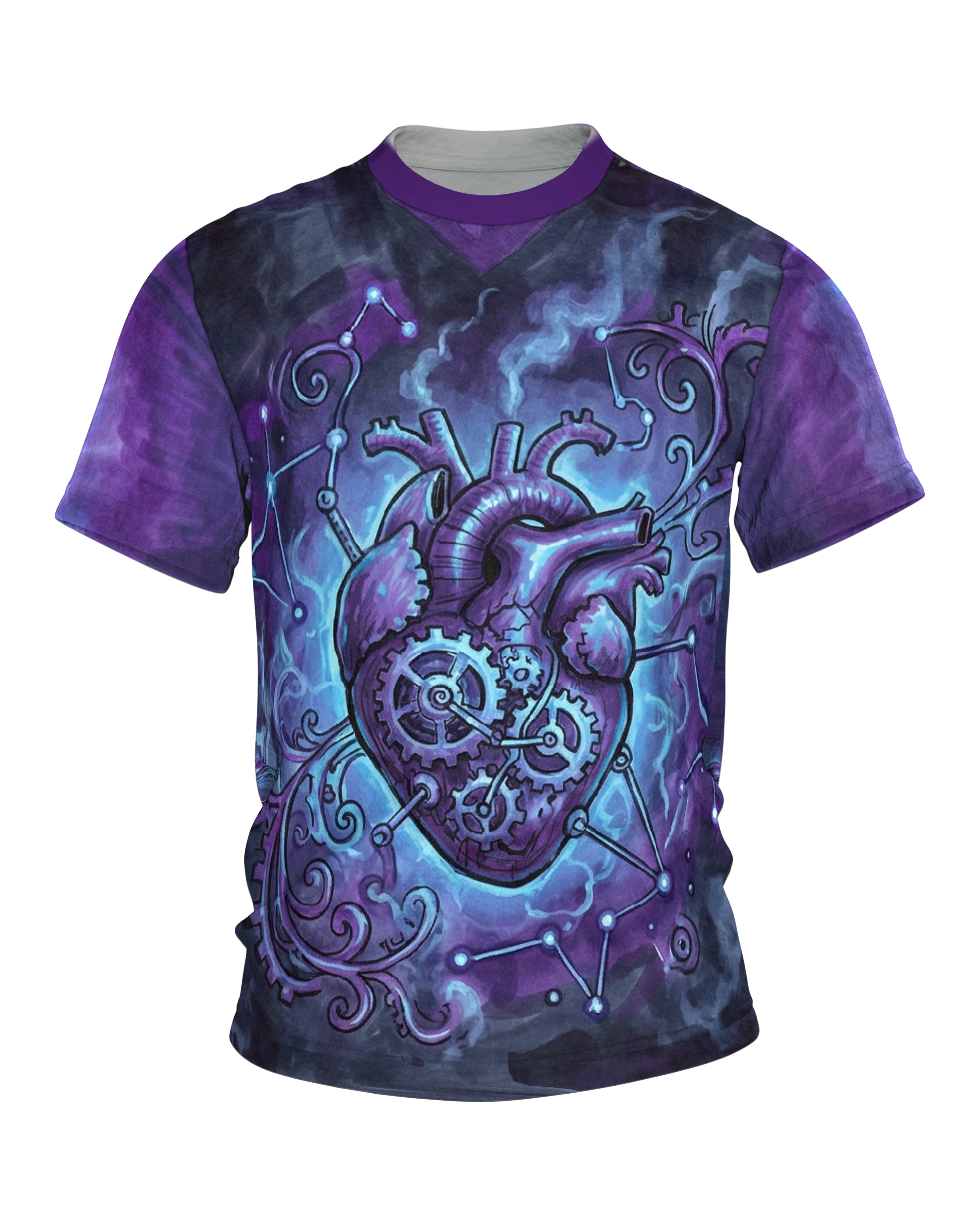
At the center of this shirt beats an anatomically correct heart, but not one made of flesh. Made of metal. Aorta and ventricles are as clearly recognizable as in an anatomical atlas, yet where muscle should be, four gears turn in purple and cyan.
Product description
This Steampunk Heart T-shirt shows the most romantic machine part in the world. An anatomical heart, its chest opened to the night by someone. It hangs large and matter-of-fact in the middle of the front, with aorta, vessel arches and chambers. Drawn as if from an old anatomical atlas, except that inside it no muscles are working, but gears.
Four, five wheels mesh in there, cleanly mounted, with spokes and toothed rims. As if a watchmaker had taken over the heart chambers and decided that feelings would run precisely from now on. Around the organ glows a cyan-blue light, half energy, half breath, curling as smoke into the dark background. From left and right, Victorian ornamental vines grow inward, curved flourishes as if from an old book cover. And between them stretch star patterns, glowing points connected by fine lines into constellations. As if the heart were being charted against the night sky right now.
The whole thing is visibly painted, not engineered. The background lives on broad, dark brush strokes in graphite and violet. The glow is softly hazed, the vines carry light and shadow edges as if set with a marker. This painterly feel gives the technical design its warmth, it looks like an illustration from a very beautiful, very strange book of fairy tales.
The transition between the organic and the mechanical is solved especially well. The vessels open into smooth fittings, as if they had always been connectors. And where the wheels meet the heart wall there is no hard edge, but a soft shadow gradient. It fuses both worlds. Nothing looks implanted, everything looks grown, and that matter-of-factness is the real magic of the design.
On the back, the story leaves the ribcage and sets out on a journey. An airship travels through the same night there, a zeppelin. Its hull is transparent like a watch case, filled to the brim with gears in every size. Beneath it hangs a gondola shaped like a ship's hull, railing included. At the stern, fins and a propeller turn. And around the whole craft stretches a wide net of constellations, as if it were navigating along them. On the front the heart as a machine, on the back the machine with a heart, together the two sides speak of drive in both senses of the word. The constellations do not repeat: on the front they survey the heart, on the back they form the ship's route. Compare the points and you find two different skies.
The palette stays consistently nocturnal and unusual for the genre: no brass, no sepia, but violet, purple, deep graphite and glowing cyan. This cool color climate takes steampunk out of the museum case and makes it fit for the nightclub, familiar mechanics in unfamiliar light.
Worn, the shirt reads like a painting with a body. The dark all-over print is flattering, the central heart glow draws the eye. And the back rewards everyone who watches you walk away. It goes with black jeans without a second thought, with dark purple on purpose, and under open dark shirts as a glowing core.
It belongs to the romantics with a toolbox. People who find anatomical posters beautiful, who are at home at conventions. Who wear tattoos with meaning or who are simply looking for a heart that visibly works. And it is, to say it openly, an excellent gift of love for anyone who finds roses too fleeting. The person who receives it then visibly wears what you credit them with: a heart that runs and runs.
The design reveals itself in stages, and that comes from the way it is built. From a distance there is only a glowing shape against a dark ground. A step closer, aorta, chambers and vines separate from one another. Only right up close do the toothed rims become countable, along with the spokes, the bearing points and the fine lines. Those run from the star points all the way onto the heart wall.
One detail is worth a second look: the star lines do not end in empty space. They run toward the organ and land there on small pinheads, like survey points on a map. So the heart is not only lit, it is measured.
In the end the picture claims two things at once: feeling can be built, and a machine is allowed to beat. Whoever wears it wears no motto, but an open question.