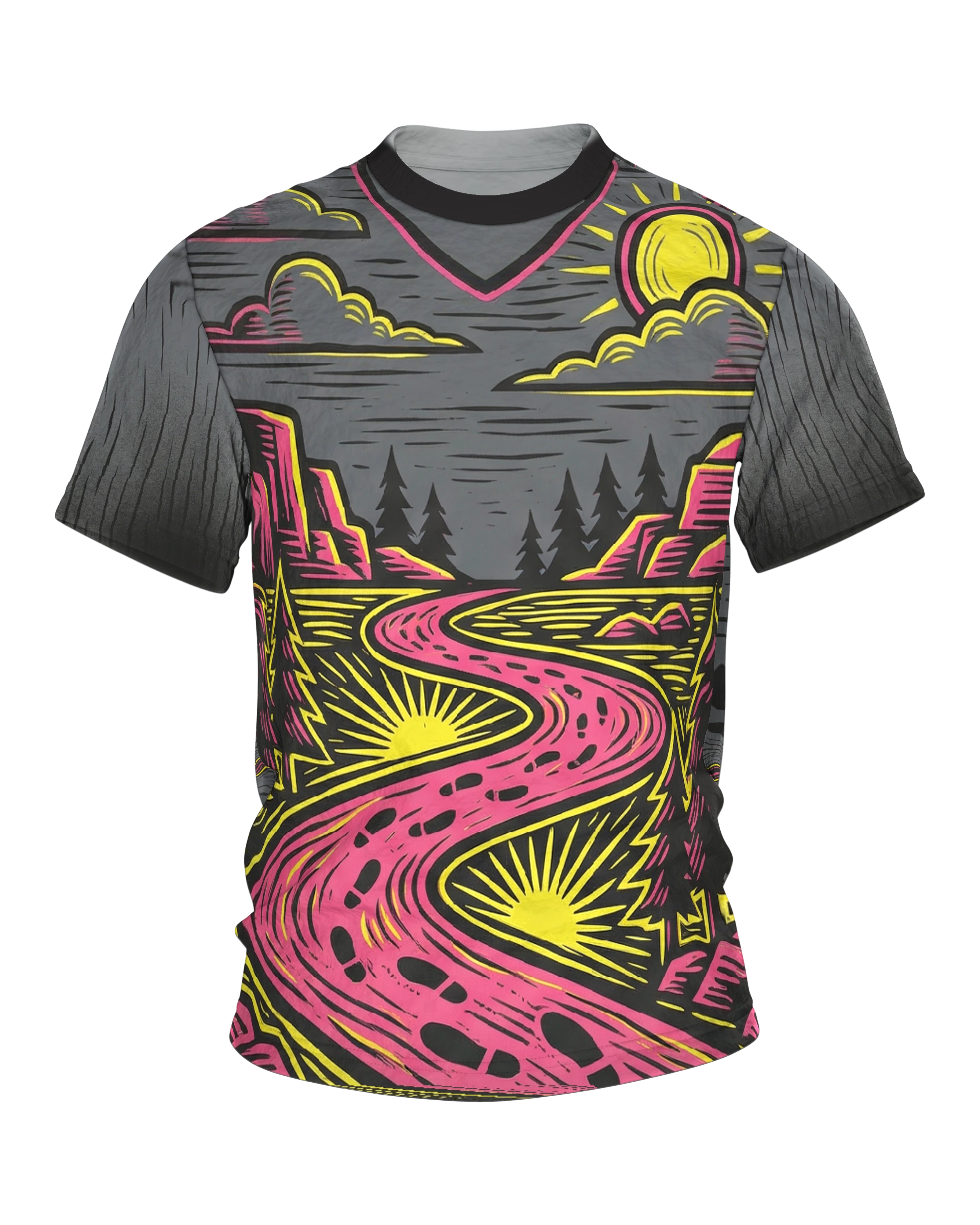
A curving road winds through a linocut landscape, but the road is not gray. It glows in bright magenta pink, almost like a synthwave visualization, pressed into the style of a classic 1930s woodcut.
Product description
This Neon Landscape T-shirt takes the oldest longing of the hiking world: the path that disappears behind the horizon. It prints it in colors that exist in no hiking guide. Magenta and neon yellow on granite gray, cut in the angular language of the linocut.
The path is the hero of the front. Wide and glowing pink, it winds in switchbacks from the lower hem to the horizon. And look closely and you will recognize the dark imprints of boot soles in its surface, tread by tread. As if someone had walked through here just moments ago. To the left and right it is lined by the residents of this unreal wilderness: mesas and cliffs in layered magenta. Conifers whose branches fan out like yellow bundles of rays, dark fir silhouettes in the distance and radiant circles of light at the side of the path, half bush, half reflected light. Above it stretches a gray hatched sky with bands of cloud, and in the upper right the sun breaks through between the clouds with a full corona of rays. A yellow disc in a pink ring.
The back is the legend to this map: a large eight-pointed compass rose in pink, yellow and black. Printed onto a ground of fine radiating lines. And all around it, what you find on real paths when you lower your gaze: animal tracks. Cloven hoof prints, paw pads, small trails circle the rose as if it were a clearing. In the corners sit leaves with pink contours and yellow veins. A pink frame holds it all together. So the path in front, the orientation at the back, along with everyone else who uses the path.
The linocut style gives the whole thing its power: hard contours, angular hatching, visible cut marks in every surface. It is the technique of old hiking posters and national park prints, only in a palette that sounds more like a festival night than like early morning dew. It is exactly this friction, hiking tradition meets neon, that makes the motif unmistakable.
The composition works with an old poster trick. The switchbacks taper toward the back and the backdrops are staggered in ever darker layers. This creates real depth, although every single surface stays as flat as a stamp. The eye accepts the invitation. It actually walks the path several times, from the hem to the sun and back again. A built-in walk for in between.
Worn, it practically glows off the fabric: the gray of the shirt becomes part of the sky. Magenta and yellow leap out of it, and the switchbacks automatically pull the eye upward. It goes with black pants and dark denim, and at festivals anyway. And yes, it actually works on real hiking trails too. There it is reliably the only one of its kind. And whoever stops at the inn after the tour automatically carries the best anecdote on their body. The question about the pink path reliably comes before the first drink.
It belongs to the outdoor people with a sense of exaggeration: hikers who collect sunrises, van travelers, festival campers, linocut fans. And everyone whose mental hiking map is more colorful than the one in the backpack. And those who automatically roll down the window at the word road trip, whether or not a car is there.
Two details are worth a second look: the cloud bands carry their light edges alternately in pink and in yellow, never both on the same edge. And the sole prints in the path get smaller toward the back, pair by pair, until at the horizon they are nothing but dots.
As a gift it hits every person who is already planning the next outing on Monday. The boot prints are printed right into the path, sole by sole with visible tread. The tracks on the back, by contrast, belong to hoofed animals and paw walkers, cleanly separated into two kinds of trail. If you like, look for the two circles of rays at the side of the path the first time you wear it, half bush, half rising sun. They sit deep between the switchbacks and easily stay undiscovered for weeks, and it is exactly such late finds that keep a motif alive.