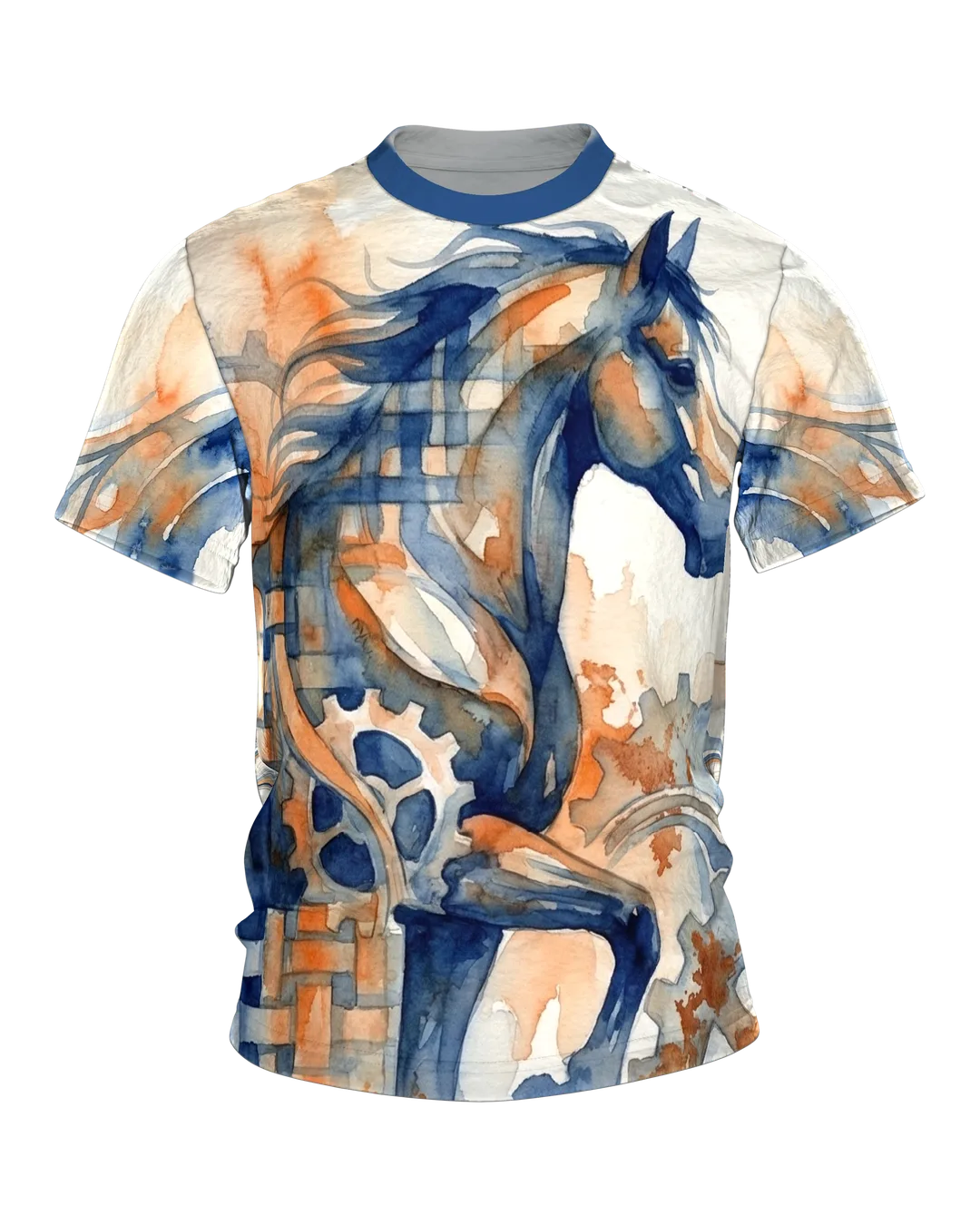
A horse whose body is built from half-mechanical gears and steel structures, overlaid with flowing watercolor swirls in navy blue and rust orange.
Product description
The Mechanical Horse T-shirt captures a moment in which nothing is running yet and everything is nevertheless ready. On the front, a horse's bust turns to the right in profile, the head lowered a little, the nostrils in quiet attention. The mane breaks apart into blue strands that trail backward like fine smoke, now dipped deep in navy blue, now lightened by cream. Across the forehead and cheek a warm rust orange gathers, giving the figure its contour and at the same time tying it into the surrounding clouds of color.
The further the eye travels downward, the more clearly a quiet transformation takes place. Neck and chest do not end as fur but grow into a mechanism of gears. Braided bands wrap around the torso like woven metal, between them sit gears in blue and rust, while narrow arcs and tubes push into one another. Some edges carry a fine patina, as if time had already worked on them long before anything had even turned. So the animal stands before the viewer half of muscle and half of construction, without one displacing the other.
In the lower area a large, rusty gear rests on the right, heavy and patient, as if waiting for its cue. Behind the head, orange watercolor clouds rise, and pale outlines of wheels fill the ground without crowding to the front. Nothing in this scene is in a hurry. It is the state just before the first swing, that held breath in which power is still pure possibility and the entire tension lies hidden.
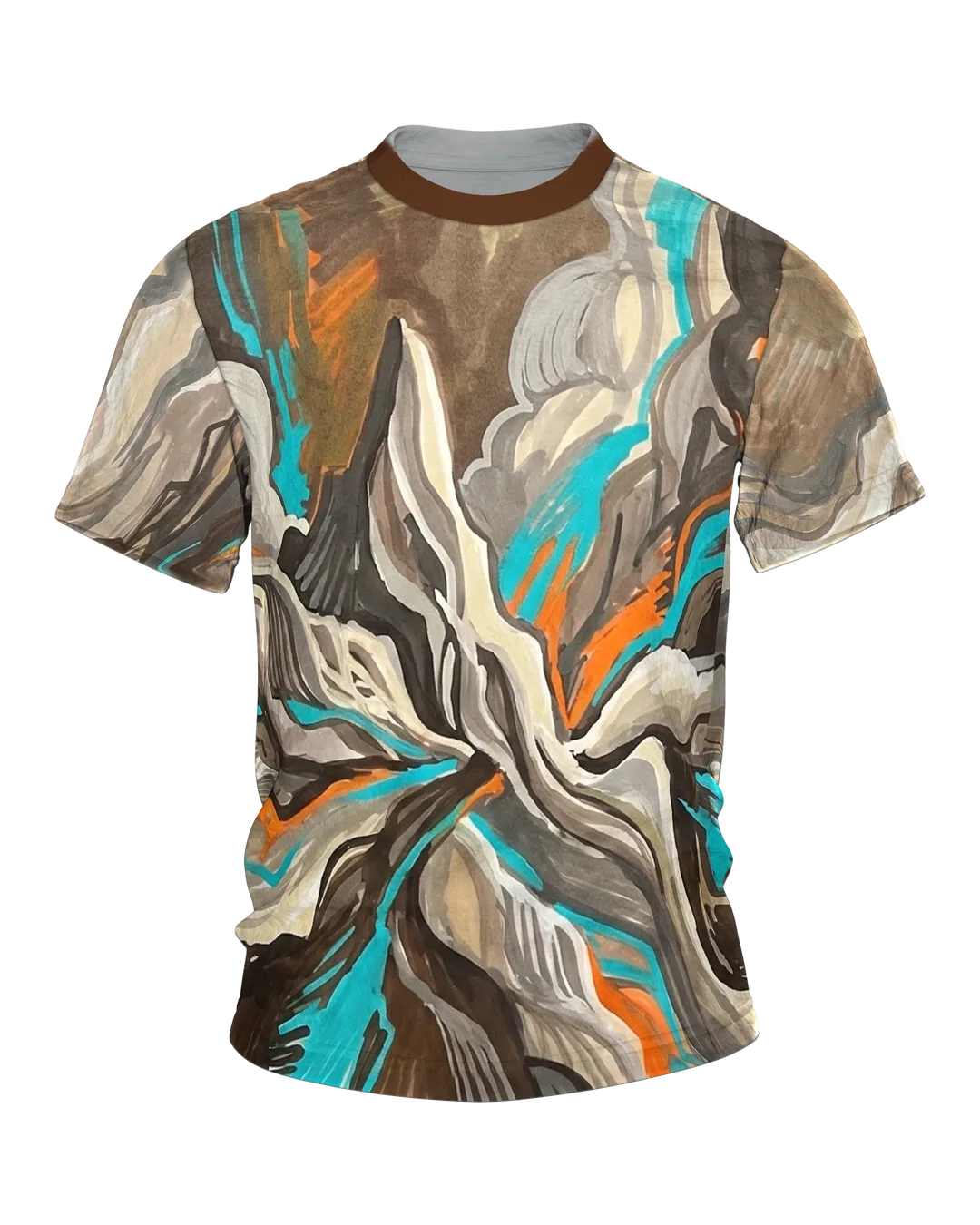
The back deliberately does without the animal and carries the narration on by other means. A curved vine of blue and orange runs from the bottom left to the top right, set with several gears, volutes and spirals that bring rolled-up springs to mind. The shapes stay soft, leave bright openings free and look as if they were floating just above the ground. In this way the back gets a quiet melody of its own, one that takes up the picture on the front and spins it on more openly, more airily.
The real appeal lies in the tone of the whole. Where mechanics usually appear hard, shiny and angular, here everything stays watercolor-soft, bleeding, almost translucent. Navy blue, rust orange and cream flow into one another instead of separating with sharp lines. This creates a picture that contemplates rather than makes noise, that turns its energy inward and radiates the composure of a mechanism that has been wound up and now waits patiently for the moment when it begins to tick.
The two lead colors play their parts as well. The navy blue feels cool and composed, almost like night air, while the rust orange carries warmth and a little transience into it, the way rust speaks of time lived through. Between these poles the whole picture swings and finds a balance that turns out neither frosty nor overheated, but pleasantly even.
It is precisely this restraint that makes the motif so appealing. It does not seek the loud entrance but rewards the second look, the one that finds the small gears between the strands, the patina on the edge of a tube, the exact point at which fur tips over into metal. There is nothing restless about it, because the whole narration revolves around pausing, around the concentrated stillness before the first stir. The horse appears in it not as a restless creature but as a carefully built clockwork that still keeps all of its power to itself.
Worn on the body it becomes a quiet statement for people who like horses and at the same time enjoy the union of fine mechanics and color. Front and back share the theme, so there is something to discover all the way around. The design is fixed as a print artwork, which is why every piece shows the same considered image.