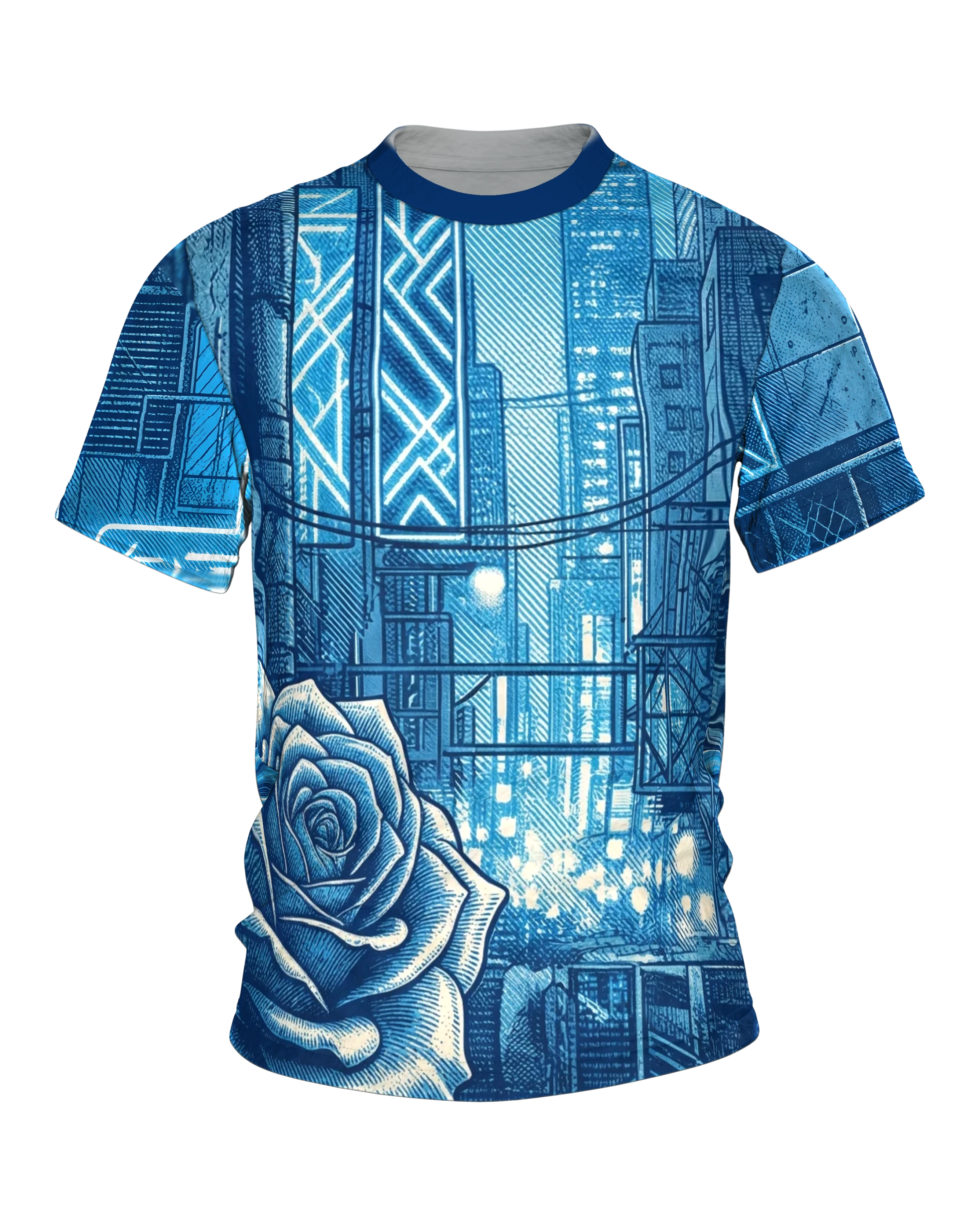
A double-sided composition where botany and big city merge. At the lower left, a large pencil-drawn rose grows up into the image from below, every petal outline structured by dense hatching, almost like a copperplate engraving.
Product description
This Cyberpunk Rose T-shirt places the oldest flower in art history right in the middle of the city of the day after tomorrow and lets both speak the same language: engraving. Across the entire front runs a nocturnal canyon of buildings in blue monochrome. High-rises made of fine layers of hatching, neon signs with abstract luminous patterns, power cables, scaffolding bridges. At the bottom lies the bokeh of a street full of lights. And on its corner, where nobody planted it, a rose is in bloom.
It is engraved in the same manner as the city, cross-hatching for the shadows, cream-colored highlights on the edges of the leaves, and it is exactly this technical kinship that makes the point: the rose is no foreign body here, it is a fellow resident. Grown between concrete and advertising, lit by the same neon, drawn by the same hand. If you like, you can read into it the friendliest forecast of the future a shirt can carry: it grows anyway.
The city deserves a second look, because it is more backdrop than menace. Its perspective recedes cleanly into the depth of the canyon. The facades alternate between dense and open layers of hatching the way lit and dark floors do. And the cables above the street hang in exactly the tired arc that real cables take on after years. Anyone who loves cities recognizes no dystopia here, but a perfectly normal Tuesday evening, only drawn more beautifully.
The back reverses the balance of power. There the rose has become monumental: one bloom in full engraved splendor fills the back, with stem and jagged leaves below it. The city shrinks behind it into a backdrop, with scaffolding on the left, light trails of moving cars at the bottom and window grids in the haze. On the front it grows on the corner, on the back it has taken over, and between the two lies only the question of how long you can ignore nature. The answer of the shirt: not long.
Stylistically the design sits between banknote engraving and graphic novel: the hatching is fine enough for the eyes of collectors, the composition bold enough for the street. Everything stays within a single blue spectrum, from deep night to electric sky blue, with cream as light, no pink, no chrome kitsch, only engraving and current. In a cyberpunk context this restraint is the real rebellion, the genre usually shouts, this design speaks quietly and stays in your ear longer for it.
Worn, it is the rare flower design with city DNA. It works better on the subway than in the garden, and it goes with denim as well as with techwear. It attracts two kinds of compliments: one for the rose, one for the city, depending on who happens to be looking.
It belongs to the romantics with a monthly pass: people who walk through cities at night and greet plants on traffic islands, sci-fi readers, engraving lovers, tattooed people with a fine-line collection and everyone who knows that tenderness and concrete do not rule each other out.
As a gift it says something you can rarely say out loud without sounding grandiose: you are the blooming thing here. Engraved and wired at Isakum, with the right of way left to the rose. The rose took it, as you can see, and nobody here regrets it.
Anyone who wears the shirt regularly develops a relationship with its two tempos. The front has the restlessness of the street, the pull of the vanishing point, the flicker of the signs. The back has the calm of a flower that has to be nowhere. Depending on the day you turn one truth or the other toward the person in front of you, and both are true, that is the luxury of double-sided designs. And because with city motifs people often ask about the original: this canyon exists nowhere and everywhere, it was pulled together from evening walks through many cities, its corners look familiar to everyone and still belong to no street map. Places like that are the ones you wear most gladly, they argue with nobody's memory.