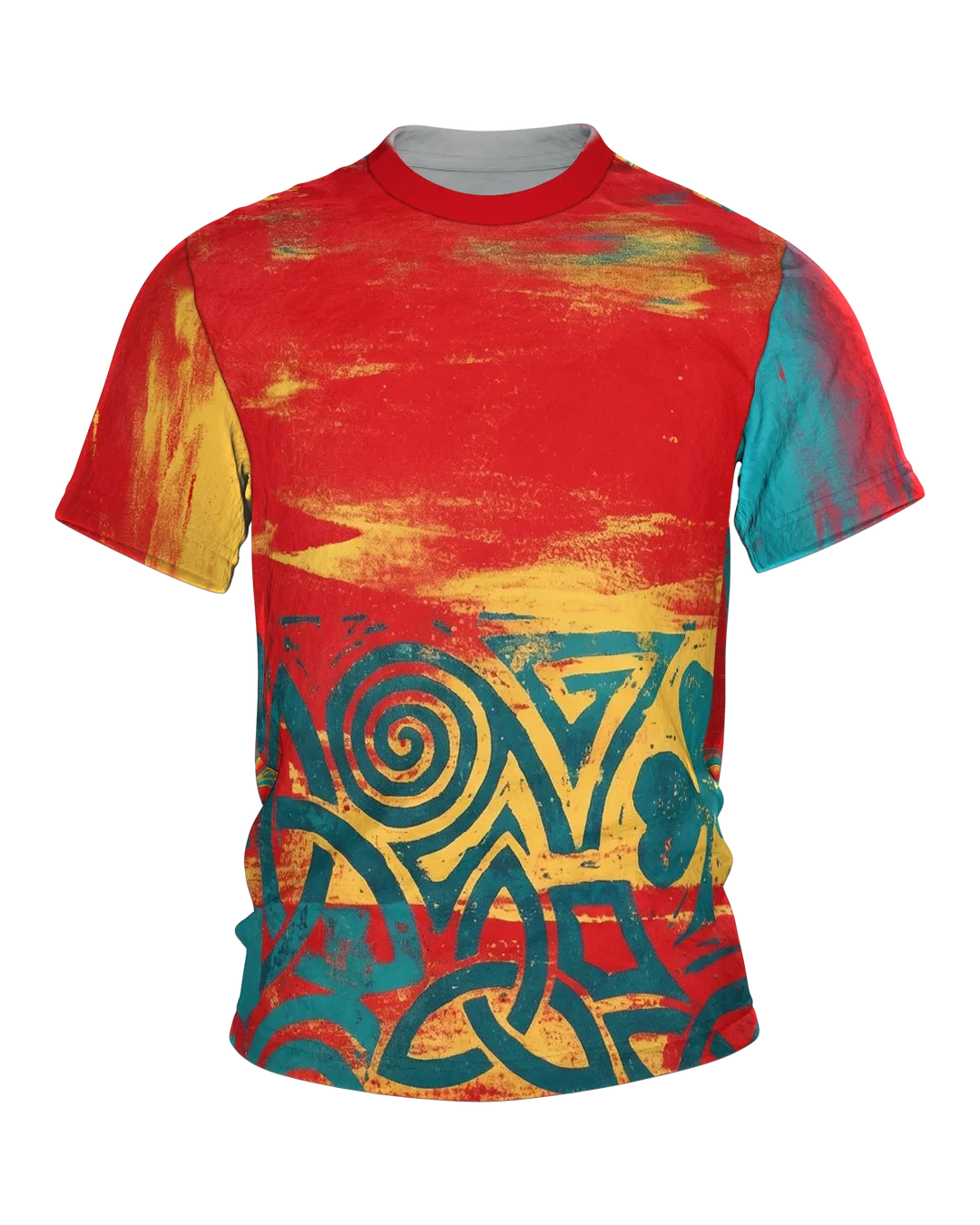
This shirt feels like a worn travel poster from a pub in Galway. Fiery red with mustard yellow streaks runs across the upper half, like rolled-on printing ink that was pressed unevenly onto the paper.
Product description
This Celtic Knot T-shirt carries its symbols the way an old wall carries its layers of paint. Below lies a dense frieze of Celtic signs in petrol. Above it stands a sky of fiery red, wiped through with mustard yellow, as if someone had painted over an Irish sunset with a broad brush.
The frieze in the lower half is the heart of the front. On the left, a spiral rolls inward at even spacing, the oldest sign for becoming and returning. Beside it, Trinity knots interlace into their characteristic three-arc figures, one large example in the center, more of them cropped at the edge as if the band continued underneath the fabric. And on the right, on a mustard yellow field, sits a rich shamrock, three-leafed, the friendliest word in the Celtic vocabulary of shapes. All the signs stand in deep petrol on a shifting ground of red and mustard yellow, with the rough edges of a stencil print on stone.
The upper half belongs to the painting: broad, horizontal swathes in red, shot through with yellow and petrol-colored streaks, like an evening sky above a peat fire. This division gives the shirt its architecture, the foundation of signs below, the open space above, and as an all-over print the whole shirt is painted, while the frieze itself appears only on the front.
The back leaves the order of the frieze behind and lets the symbols rotate freely. Trinity knots in different sizes and rotations spread across the full surface. Between them stands a large half-circle with spokes, like a fragment of a Celtic shield. The same layers of paint in red, yellow and petrol lie over everything. On the front the wall speaks in a single line, on the back in a full choir.
Every sign carries its old meaning along. The spiral stands for movement and change, the Trinity knot for connection with no beginning and no end. The shamrock stands for the luck you do not have to go looking for. You can wear the shirt as a pure celebration of color or as a small lexicon, both work.
The painted ground deserves a look of its own: the red swathes do not run parallel, they overlap at slightly tilted angles, like coats of paint from different years. In two or three places the mustard yellow breaks through like plaster under paint, and that is exactly where the eye gets caught. Aged walls tell their story in holes, not in surfaces.
The croppings in the frieze are deliberate too: on the left, the side seam cuts into heart-shaped leaf forms, on the right a band runs out of the picture. This lets the frieze claim to be older and longer than the shirt, a fragment of something large, and fragments are easier to believe than complete pictures.
This Celtic Knot T-shirt belongs to people with a longing for the northwest: the traveler to Ireland who picks her pubs by the music. The fan of Celtic history who can tell a spiral from a triquetra. Everyone who loves a grunge look when it has substance.
Count the signs and you find five complete and three cropped ones on the front, seven in free rotation on the back, and no knot repeats its neighbor's size exactly. That scatter keeps the surface alive, ornament only becomes a wall once it breathes.
It wears like a banner at a festival, like a travel souvenir with jeans, and in winter under a cardigan like a promise about next summer.
The all-over print covers the entire surface, so there is no base color to choose: every piece shows the same layers of red, mustard yellow and petrol, with the same rough edges and the same spots where the yellow breaks through.
The color hierarchy, by the way, follows pub logic: red like the facade, mustard yellow like the light behind the panes, petrol like the door you want to walk through. Anyone who has once walked through Galway recognizes the palette immediately, it hangs on every second corner there.
As a gift it hits Ireland-loving hearts right in their homesickness, even if they never lived there. Painted at Isakum, with peat in the brush.