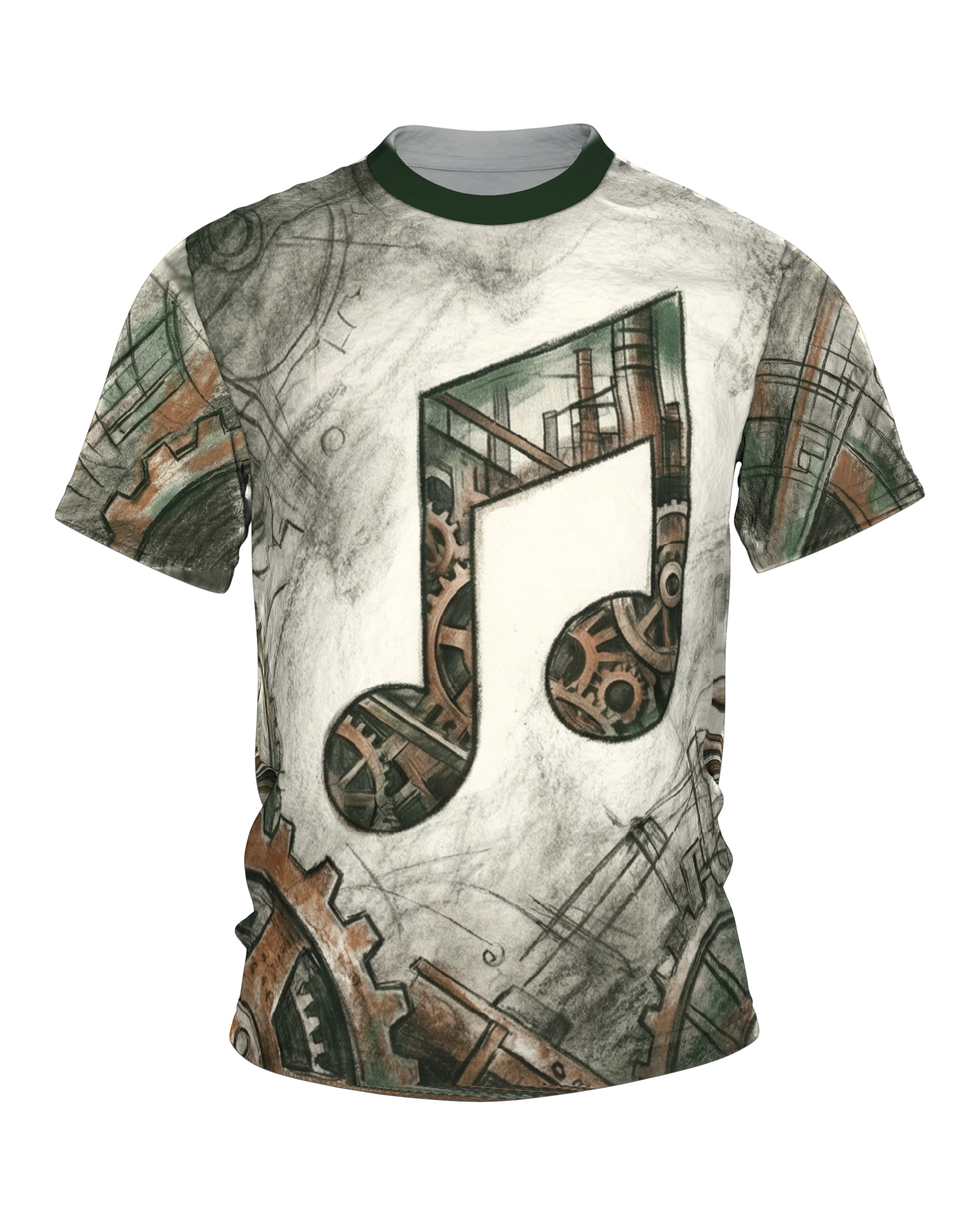
A double eighth note, but not drawn in smooth ink. The two note heads are made of ticking gears and clockwork mechanisms.
Product description
The Steampunk Music Note T-shirt puts a large double eighth note at the center, drawn in charcoal and delicate pastel tones on a light ground. The note looks as if someone had unscrewed an instrument and checked what holds the sound inside. The beam connecting the two note heads is opened at the top like a window, and behind it lies a whole industrial scene: slim chimneys, staggered factory halls and slanted struts, kept in muted green and warm rust. So you are not looking at a mere symbol, but through the note into a small workshop hall.
The two note heads are filled with gears, shafts and machine parts in rust brown. Teeth grip teeth, one axle leads into the next, and the eye wanders from one small wheel to the next, as if a movement were being set off. Individual teeth are hatched so precisely that you almost think you can hear them mesh. This way the motif starts quietly and builds up piece by piece, like a first entry that hesitates at first and then carries.
Around the note a cloudy hatching curves in gray and muted green. This charcoal surface is deliberately left visible, with single strokes and soft smudges, so the hand drawing never disappears behind smooth perfection. In the upper left, sketched gear outlines and fine compass lines appear, as on a half-finished draft. The compass lines swing out in wide arcs, as if someone had struck circles here before the actual drawing began. To their right stand delicate technical scaffold sketches, thin and precise. Both frame the note without crowding it, and hold the beat of the picture together.
At the lower hem the motif grows stronger. There lie sturdy, rusty gears with clearly set rivets, and between them a long tube that recalls a telescope. These heavy forms give the drawing a foundation and let the delicate note above appear lighter. The contrast between the coarse wheels below and the open field of the note heads makes the eye return again and again to the melody above.
On the back the idea continues, this time more solid. Against a cream white ground stands a double eighth note that looks as if it had been assembled from metal plates. Green patina and traces of rust run across the surfaces, and rivets line up along the edges. Here the note heads themselves have become large gears, and further wheels reach into the shape from left and right. A long rod runs diagonally through the picture and ties the parts together, as if it held the whole works under tension.
Behind this metal note, wide smudged charcoal areas spread out, along with circle and angle lines as on a construction sheet. That makes the back read like the technical drawing for the front, calmer in structure and clear in line. On the front the opened note with a view inside, on the back the built note as the result: two views of the same instrument, made of wheels instead of strings.
In color the motif stays restrained. Rust brown, patina green and many shades of gray set the tone, applied in a manner that brings a sketchbook to mind rather than high gloss. Nothing shines, everything stays matte, as if a fine dust from the workshop lay over the sheet. Exactly this mixture of precise construction and visible hand is the appeal. The motif wears unobtrusively and at the same time rewards a closer look, because there is another detail in every little wheel.
Anyone who loves music and at the same time has a weakness for old workshops, mechanics and the charm of worn metal will find a design here that brings both worlds together in a single note. At Isakum the drawing is laid out so that melody and machine do not work against each other, but pick up the same rhythm and only come fully together in the resonance afterward.