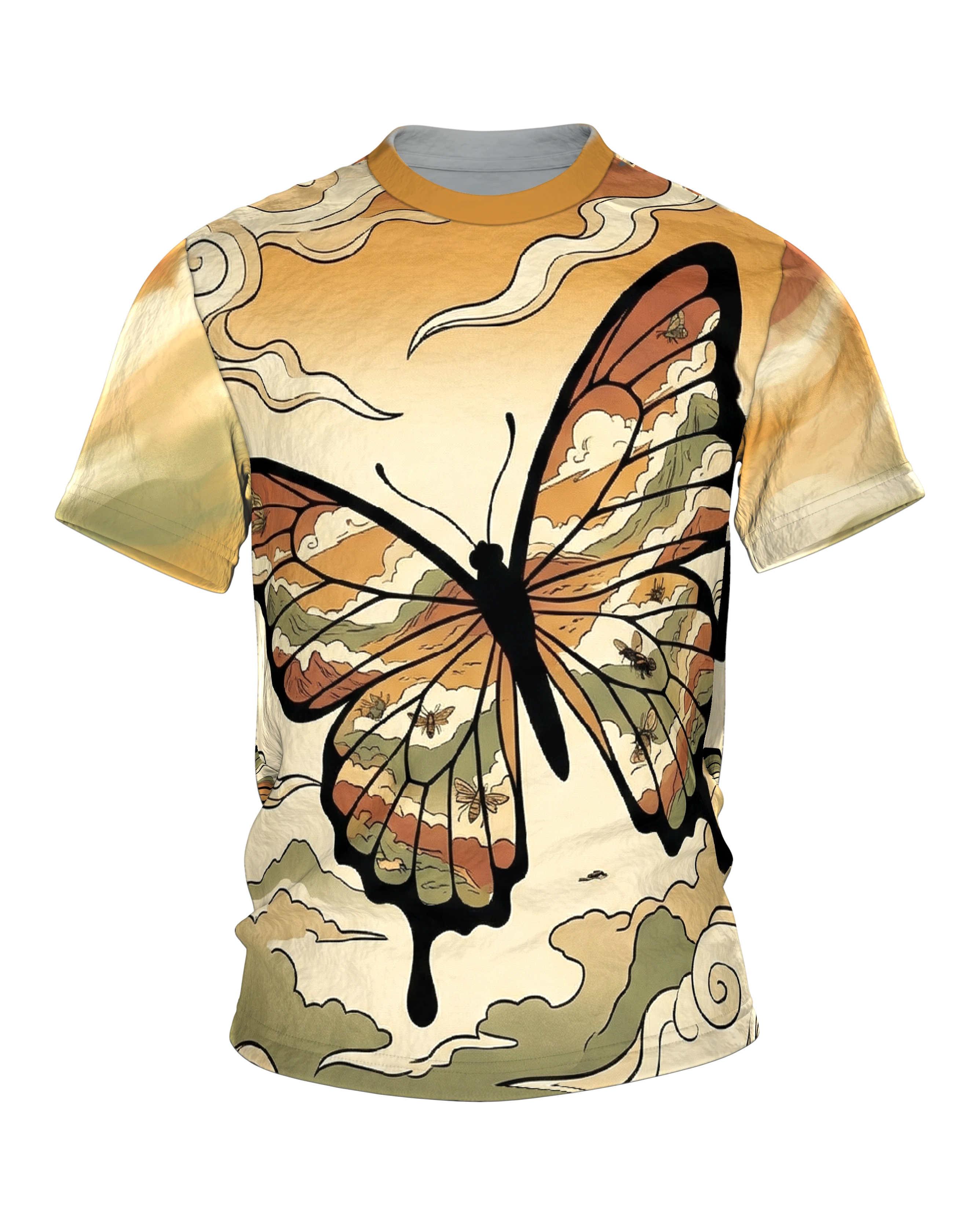
A single large butterfly spans its wings across the chest. The wing panels are not colored, they are filled: with mountain ranges, cloud bands and evening stripes in Japanese woodblock style.
Product description
This Butterfly Ukiyo-e T-shirt is based on a simple question: what if wings carried no patterns, but views? The large butterfly spans its wings across the chest. It is a flying window. Whole landscapes lie in its panels, mountain ranges in fir green and rust, banked cloud bands, stripes of an evening sky. Everything is rendered in the manner of Japanese woodblock prints and structured by black wing veins like the lead cames of a church window.
And then there are the residents. Come close and you will discover tiny insect silhouettes in the panels. A bumblebee here, a moth there, a beetle in the neighboring panel, as if the small world had hidden inside the large one. There are more than half a dozen of them, and one of them even flies outside the wings through the open sky. This search game is the quiet humor of the motif: a butterfly that carries other insects along for a walk.
Around the butterfly, the evening glows. The sky runs from rich rust orange at the top to warm cream in the middle. It is threaded with the curved spiral clouds of the Japanese printing tradition, which curl at the edges like smoke with manners. Below, green ranges of hills round off the scene, and the butterfly is just flying across them.
The back zooms in, the way only fabric can. There a single wing fills almost the whole surface, cropped by the body lying to the right with its long antennae. In this enlargement, the landscape fillings become the main event. Mountains and clouds grow to monumental size, and the hidden insects are now large enough to call them by name. In front the whole butterfly above the world, at the back the world inside one wing.
Compositionally, the image lives on a slight rotation. The butterfly does not stand there in mirror symmetry, but tilted. The right forewing rises steeply upward, the left one lies flatter and reaches almost to the edge. From the left hindwing a long black tail hangs down and ends in a drop. In this way the calm surface gets a direction without the order starting to wobble.
The palette stays warm and earthy: rust orange, sepia, fir green and cream, held together by deep black veins and contours. These are autumn colors in the best sense. Tones that go with jeans just as naturally as with corduroy and linen, and that give the image a warmth that neon bright butterfly motifs never reach.
The motif has two speeds. From a distance it is an elegant large butterfly against an evening sky, a calm, almost classical picture. Up close, the second level opens up: the landscapes, the mini insects, the zoom on the back. The pull comes from a single trick, namely that the mountain ridges continue across the black veins and turn the individual wing panels into a coherent panorama.
It belongs to the attentive ones: people who miss the magnifying glass in museums. Nature lovers who also greet the small species. Admirers of Japanese graphic art. And everyone who finds transformation not only beautiful but meaningful, after all the butterfly remains the oldest symbol for it.
As a gift it combines love of nature and a sense of art without a gram of kitsch. Anyone who has found all the hidden insects may consider themselves a connoisseur of the piece. We will only reveal this much: there are more than three, and one of them does not sit in a wing, but floats freely in the evening sky below.
Finally, a look at the color temperature. Rust, ocher and sepia are exactly the tones that hang on the trees outside in October, and the fir green of the mountain ranges holds its own against them. This mixture belongs to the transitional season, but it already works in late summer, because the sky gradient stays bright and never tips into darkness.