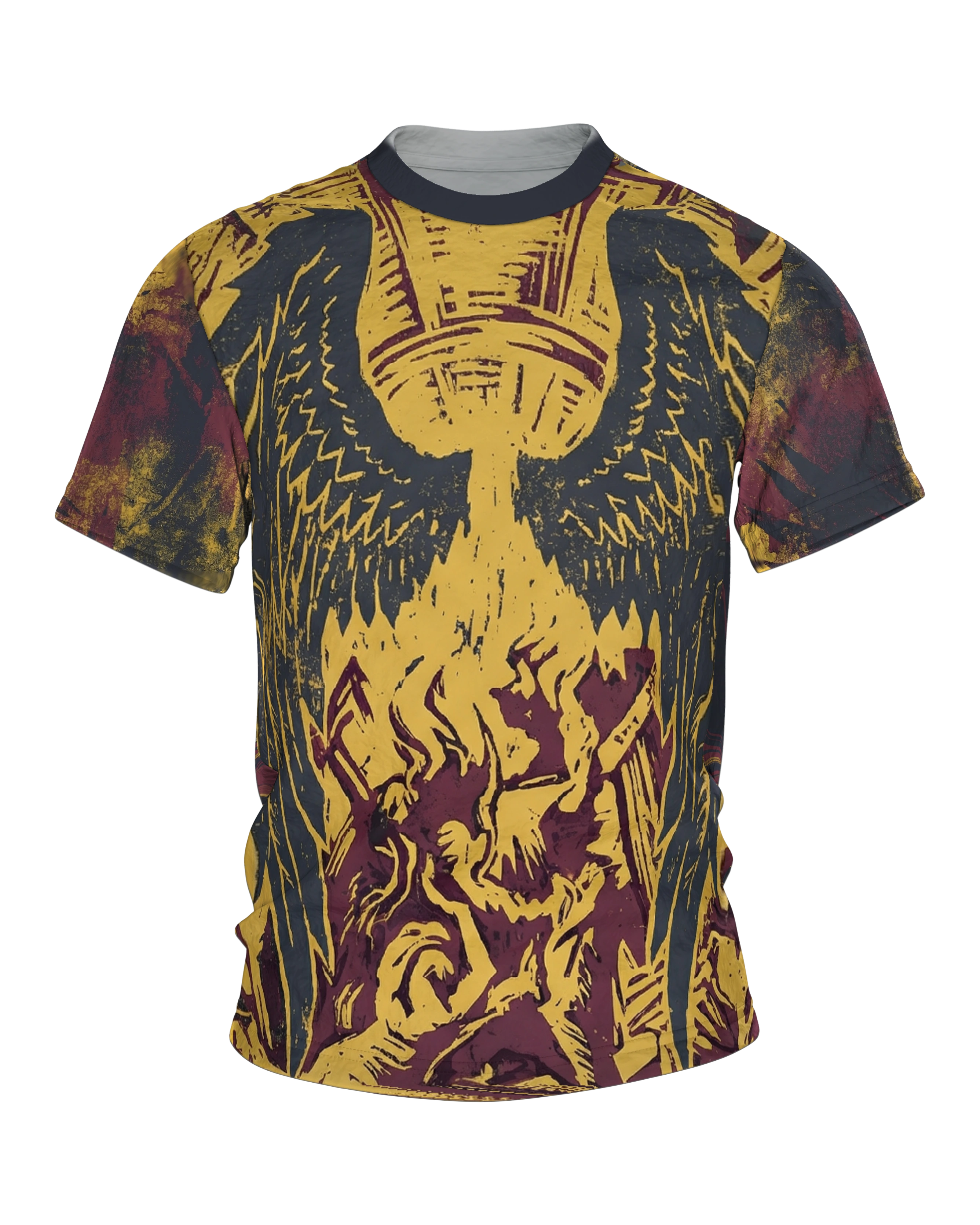
An angelic being in woodcut, its body a mustard yellow silhouette, its wings slate blue with angular rows of feathers. Instead of a head there is a broad crown band running off the top of the image, and below, flames leap upward.
Product description
This Phoenix Angel T-shirt carries the oldest transformation story of humankind across the chest. It is told in the hardest visual language print history knows. Across the whole front a winged figure rises out of a sea of flames. Every line looks as if it had been lifted from the block with a knife. Rough, decisive, without a single soft edge.
The wings dominate the image. Two mighty wings in black-blue spread out into the shoulder area. Their feathers are not painted but cut. Row upon row of angular hatching stands one above the other, dense near the body, more open toward the tips. Between them the figure stretches upward, a yellow silhouette somewhere between human, bird and flame.
Where the head should be, a broad yellow disk opens up. Burgundy bands of hatching lie across it like spokes, half crown, half halo. From the upper corners yellow bands run out to the edge. They bring order to the upper picture space and give the ascent a destination.
Below, it burns. The base is a field of flames in deep burgundy with yellow tips. Look closely and you find curved shapes in it that can be read as heads, backs and raised arms. The old stays behind while the new rises. That very doubling has kept the phoenix myth alive for thousands of years.
The color world stays limited to three tones. Mustard yellow like yellowed paper, burgundy like old wine, black-blue like printer's ink. Added to that are the traces of a hand-pulled print. The ink density fluctuates, the knife frays the edges, small gaps stay in place. That irregularity is not a mistake, it is the proof of the technique.
The mustard yellow is the real decision. It keeps the dark image warm and takes the gloom out of it. Without that tone the ascent would be a threat; with it, it becomes a promise. That is why the yellow also lies where the figure itself stands, and not only in the fire.
Compositionally the front follows an ancient visual formula. Chaos below, the ascent in the middle, ordered light above. You know this three-part division from altarpieces and old book pages. The eye climbs along automatically, from the embers over the wings and up into the rays.
The back turns the binoculars around. Four or five enormous wings lie diagonally across one another and fill the surface completely. Their rows of feathers are drawn with red contours on black-blue. Yellow breaks through between them, blotchy like an unevenly rolled roller. It is rhythm instead of scene, as if you were standing so close to the rising being that nothing remains but plumage.
The image runs across the entire surface, with no frame and no free margin. The wingtips reach the side edges, the field of flames only ends at the very bottom. That makes it look not applied but dyed in, like a sheet of paper that has gone through the press.
Worn, the design has the presence of a concert poster and the depth of a museum print. From a distance the wing shape reads immediately as a figure. Up close, carving marks, outlines in the fire and the logic of the feather rows step forward. Two images in one impression, depending on how far away you stand.
It belongs to people in transformation. To everyone who has left something behind and does not want to hide it. Readers of myth find the firebird, collectors of old prints the handwriting of the knife. This angel knows no genre boundaries, because it gets by without a single word of lettering.
As a gift for a new beginning it is an embrace in picture form. If you do not find the outlines in the field of flames the first time you put it on, there is no need to search. They show themselves in the mirror, at half distance, exactly when your eyes relax. That way something is still left on the Phoenix Angel T-shirt long after the first impression has settled.