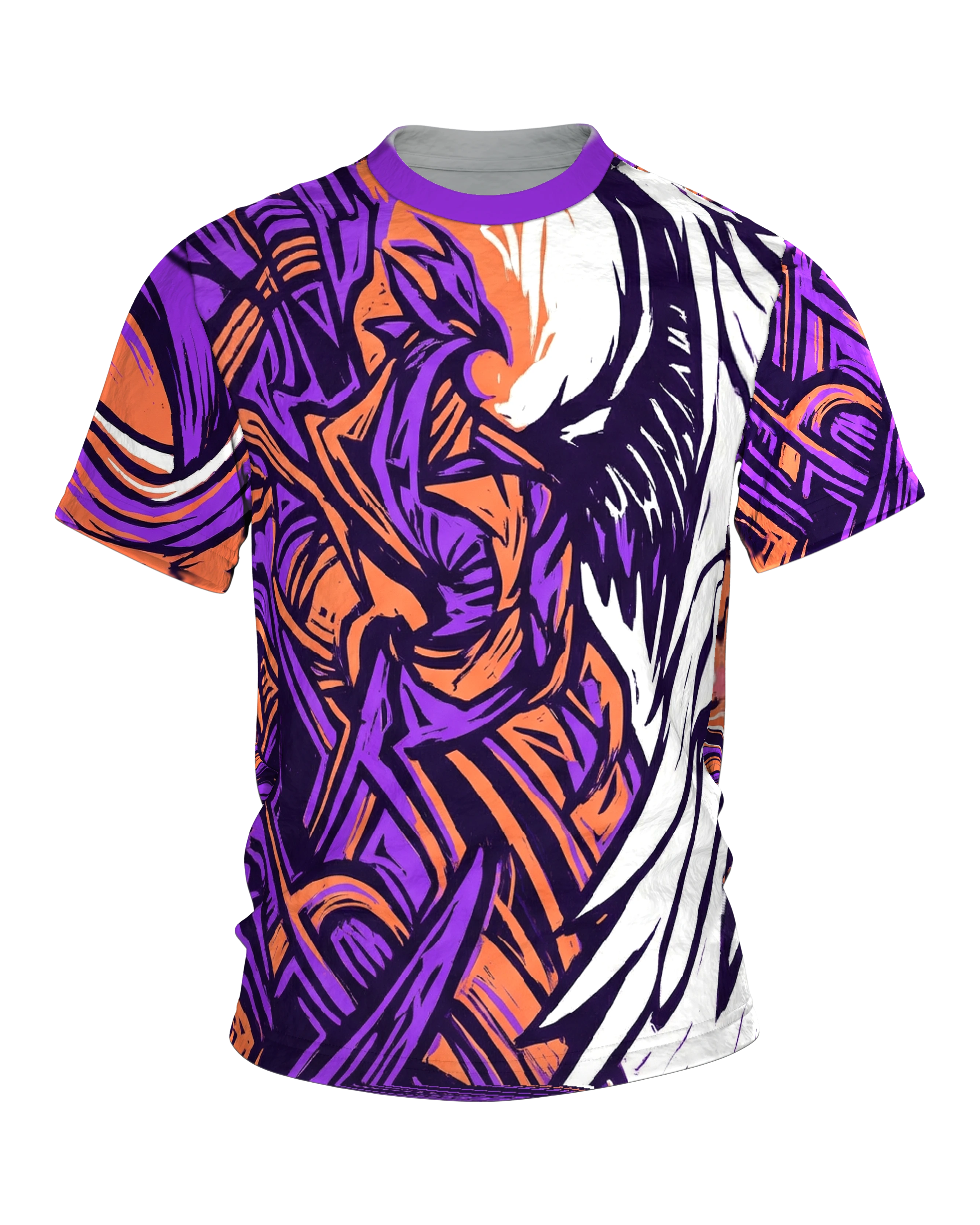
A deliberately divided design: on the right a richly detailed white angel wing with fine feather lines, spread out like a sculpture.
Product description
This Linocut Wing T-shirt splits its front into two temperaments and lets them compete against each other: on the right stands a large white wing, calm and self-assured, its feathers layered in bold black cuts, from the shoulder down to the hem. On the left, everything rages, a dense weave of violet and orange shapes, jagged points, arcs and splinters, like a storm just about to take form. And at the transition, where calm meets uproar, the chaos condenses into a bird-like silhouette, as if the creature the wing belongs to were being born out of the storm at that very moment.
The tension of this division carries the whole motif: the wing is the clearest form printmaking knows, the weave the freest, and both come from the same blade. You can see the kinship in every edge, the white feathers are cut with the same decisive strokes as the violet swirls, only with the opposite intent, order here, discharge there.
The longer you look, the more the reading tips over, and that is intended: sometimes the storm looks like the material the wing is just now forming out of, sometimes like what it is leaving behind. Are feathers being born here, or blown away? The picture never answers the question, it keeps it fresh. Motifs with open questions are, as we know, the ones that stay interesting longest.
The back then answers the question of what flying might feel like: it shows it instead of depicting it. A single large vortex of shapes fills the surface, violet and orange lobes push across one another in wide sweeps, the densest knot sits at the top center, and everything fans outward from there. No horizon, no body, no direction but rotation, it is flight from the inside, printed in linoleum.
The color choice is a deliberate three-note chord with an exclamation mark: violet and orange, the boldest complementary pair after blue and orange, plus black for the cuts and white as the figure of light. Together they make a shirt that is present in a room immediately, without calling on a single neon color, energy from contrast instead of from glare. That violet and orange work together was already known to the Fauvists; that they age so well on a shirt, because neither has ever been fully out of fashion or fully in it, is the practical bonus.
Worn, it reads like expressive printmaking in motion: the white wing stays legible as a form even in passing, the weave beside it shimmers, and the back turns every departure into an exit. It goes with black without discussion, and with dark denim that goes without saying. At concerts and in galleries it is equally right.
It belongs to people with two speeds: those who seem calm on the outside and spin on the inside, or the other way around; the shirt tells both versions just as gladly. Printmaking fans love the blade work, lovers of expressionism the discharge, and everyone else simply an unusually energetic piece of graphic art.
The bird's head at the seam point is the secret lead of the motif. A curved beak built from violet wedges, and in the middle of it a single round orange dot as an eye. It looks over toward the wing, not at the viewer. Once you have found it, you will never see the left half as a mere pattern again.
As a gift it suits anyone standing between gathering themselves and setting off; the wing is already there, the motif says, the rest is the jump. Which part wins out while you wear it is up to the day, the shirt is prepared for both.
Finally a word about the white, because it is the rarest color in the whole picture. On the front it appears only in the wing, nowhere else. That makes the wing read as light and everything else as matter. On the back it returns, but only as a thin crescent along a few edges. There it marks exactly the places where two shapes lie on top of one another. A picture that draws its power from violet and orange needs no more white than that.